
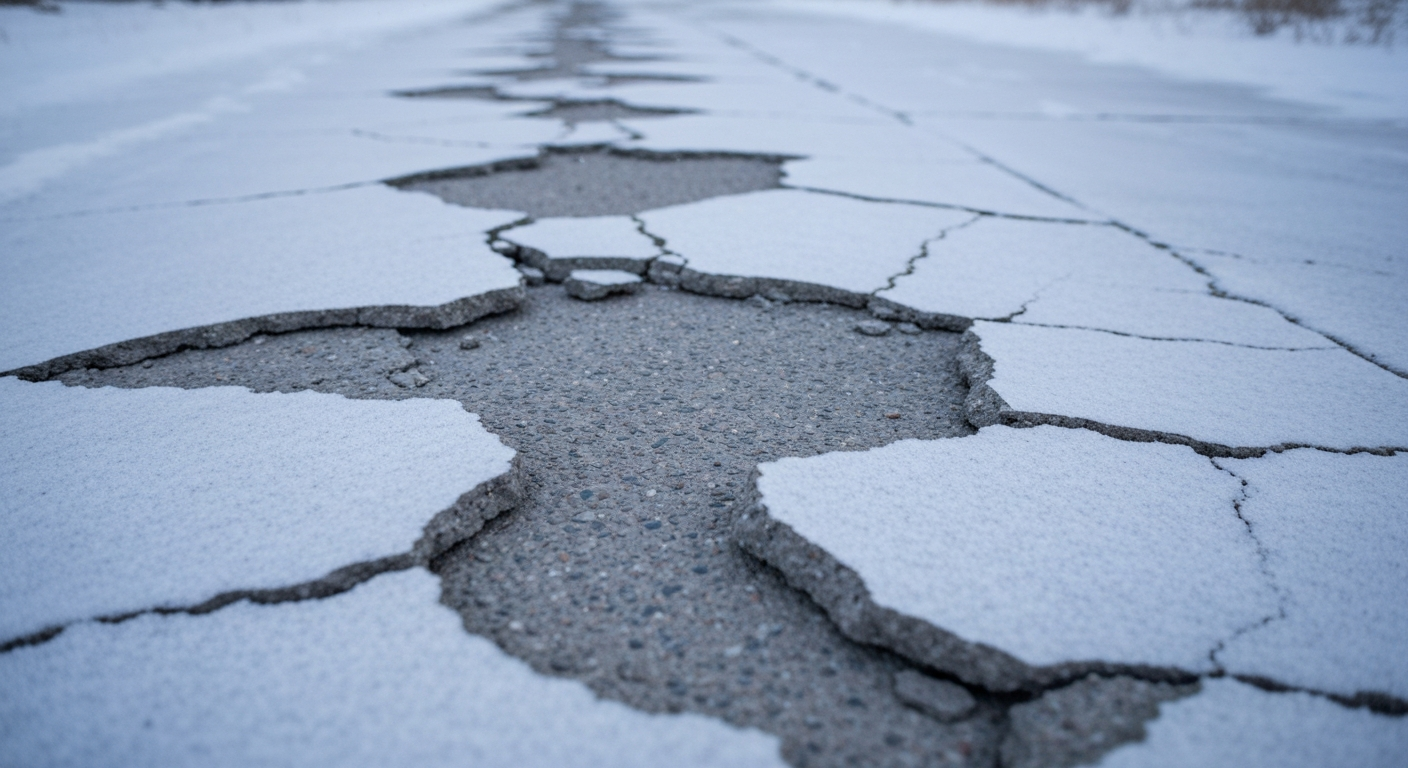
The main reason why concrete spalls in Montana is that moisture enters the surface, freezes, expands, and places pressure on the cement paste surrounding the aggregate. Repeated freeze-thaw exposure, de-icing salts, standing snowmelt, and a weak or poorly cured surface layer can eventually cause that paste to peel, flake, or break away.
Spalling is often a surface-durability problem, but deeper cracking, movement, corrosion, or widespread deterioration can indicate that the slab has problems beyond its finish.
Quick Answer: What Causes Concrete to Spall?
Concrete spalling in Montana usually develops from a combination of moisture and repeated freezing. De-icing chemicals can keep the surface wetter and intensify freeze-thaw damage, while over-finishing, excess water, or inadequate curing can leave the top layer too weak to withstand winter exposure.
- Freeze-thaw cycling: Absorbed water freezes and creates internal pressure.
- Salt exposure: De-icers increase surface saturation and can contribute to physical or chemical deterioration.
- Weak surface paste: Improper finishing or curing leaves the upper layer more porous and fragile.
What Do Spalling, Scaling, Flaking, and Popouts Mean?
These terms are sometimes used interchangeably, but they describe slightly different forms of surface damage.
Spalling is the general loss of concrete from a surface. It may appear as shallow chips, peeling areas, broken edges, or deeper sections separating from the slab.
Scaling or flaking normally refers to thin layers of surface mortar peeling away. It often begins as small rough patches and spreads until coarse aggregate becomes visible. The National Ready Mixed Concrete Association defines scaling as localized flaking or peeling associated with freezing and thawing. NRMCA
Popouts are small, usually cone-shaped pieces that break free around an individual aggregate particle. Moisture-sensitive aggregate can contribute to some popouts, although a site inspection is needed before assigning a cause.
How This Differs From Normal Hairline Cracking
A hairline crack is a narrow line through the surface. It may result from drying shrinkage, temperature movement, or normal changes within the slab. A stable hairline crack does not automatically mean the surrounding surface is failing.
Spalling is different because material is being lost. The surface may feel sandy, sound hollow, expose aggregate, or release flakes during sweeping, washing, or snow removal.
Cracking and spalling can occur together. Water may enter an existing crack and contribute to edge deterioration, but the presence of a small crack alone does not prove that freeze-thaw damage is severe.
The Freeze-Thaw Damage Sequence
Concrete looks solid, but it contains microscopic pores and pathways that can absorb water. Damage becomes more likely when those pores approach saturation before temperatures fall.
The typical sequence is:
- Rain, melted snow, wash water, or saltwater enters the surface.
- The temperature falls below freezing while moisture remains in the pores.
- Water changes to ice and expands by approximately 9% in volume. USGS
- The expanding ice creates pressure within the cement paste.
- The slab thaws, allowing more moisture to enter weakened areas.
- Repeated cycles enlarge microscopic fractures.
- The upper paste eventually loosens, flakes, or separates from the aggregate.
A single freeze does not always produce visible damage. The problem is cumulative. Concrete that remains relatively dry may tolerate cold temperatures well, while saturated concrete can deteriorate much faster.
Air-entrained concrete is designed with microscopic air voids that give freezing moisture room to move. When the original mix lacked adequate air entrainment, had excess water, or developed a weak surface layer during finishing, winter durability may be reduced. Federal Highway Administration+1
Why De-Icing Salts Make the Problem Worse
Road salt does more than melt ice.
Salt solutions can increase the amount of moisture held near the surface and change the temperature at which that moisture freezes. This can expose the slab to additional wetting, freezing, and thawing events rather than allowing it to remain consistently frozen and relatively dry.
Vehicles also carry road brine into garages and parking areas. Snow and slush melt from the undercarriage, pool on the floor, and leave concentrated salt deposits behind. Driveway edges near public roads may receive similar exposure from traffic spray and plowed snow.
Federal Highway Administration guidance notes that chemical de-icers amplify physical freeze-thaw mechanisms by increasing saturation and affecting pressure within concrete pores. Federal Highway Administration
Chloride Exposure Is Not One Simple Reaction
Different de-icers behave differently. Sodium chloride, calcium chloride, and magnesium chloride should not be treated as chemically identical.
At lower concentrations, much of the deterioration may remain primarily physical freeze-thaw damage. Under some conditions, concentrated calcium- or magnesium-chloride solutions can also react with components of hardened cement paste and form expansive products. Concentration, drainage, concrete composition, and exposure time all affect the outcome. Federal Highway Administration
This is why a slab that repeatedly holds salty meltwater at joints, low spots, or garage entrances may deteriorate faster than a nearby slab that drains and dries.
How a Weak Surface Paste Contributes to Flaking
Freeze-thaw exposure is often the trigger, but the surface may have been vulnerable from the day it was placed.
The top fraction of an inch consists largely of cement paste and fine material. If that layer is weaker or more porous than the concrete beneath it, it can detach even when the main body of the slab remains reasonably sound.
Common contributing conditions include:
- Finishing while bleed water was still on the surface
- Adding water during finishing to make the surface easier to work
- Excessive steel troweling or overworking
- A high-water concrete mixture
- Inadequate air entrainment for exterior freeze exposure
- Insufficient curing
- Early exposure to freezing weather or de-icing chemicals
Finishing while bleed water is present can trap water near the surface and reduce the durability of the paste. Overworking may also reduce beneficial entrained air near the top. Inadequate curing limits strength development and leaves the surface more vulnerable to moisture entry. NRMCA+1
This history is usually impossible to change after the slab has hardened. The practical question becomes whether the remaining substrate is sound enough to protect or resurface.
Why the Flathead Valley Is Hard on Exposed Concrete
Kalispell and the surrounding Flathead Valley combine several conditions that encourage surface deterioration.
Temperatures Cross the Freezing Range Repeatedly
Deep cold matters, but temperatures moving back and forth across 32°F can be more damaging to a wet surface. National Weather Service normals for Kalispell show many March days with daytime temperatures above freezing and nighttime temperatures in the 20s. Marine Weather+1
Those air-temperature normals do not produce a fixed number of slab cycles. Sun exposure, shade, elevation, wind, surface color, and snow cover all change the temperature of the concrete itself. Even so, exposed slabs can experience dozens of surface-level freeze-thaw opportunities across a cold season.
Snow Holds Moisture Against the Surface
The weight of ordinary snow is usually not what causes scaling. The concern is prolonged moisture.
Snow can remain on a driveway, patio, walkway, or slab for days. Sunlight, vehicle heat, building heat, or a brief warm period melts part of it. The water enters the concrete, and the remaining snow may slow drying. Temperatures then fall again.
This repeated wet-freeze-thaw pattern is harder on the surface than dry cold.
Salt Arrives Even When It Is Not Applied Directly
A property owner may never spread de-icer on a garage floor, yet road brine can still arrive on tires, wheel wells, floor mats, and vehicle undercarriages.
The highest exposure is often found near garage-door openings, parking positions, driveway aprons, joints, and low areas where salty water collects.
The Repair Window Is Limited
Many penetrating sealers, repair mortars, and overlay systems require a sufficiently dry surface and minimum substrate temperature. Some also need stable weather during cleaning, preparation, application, and curing.
Late spring through early fall usually provides more workable conditions, but the correct window depends on the product and the slab. A rushed application over damp, contaminated, or unstable concrete is rarely an improvement.
Sealing Prevents; Resurfacing Repairs
Sealing and resurfacing solve different problems. Confusing the two often leads to unrealistic expectations.
| Treatment | Primary purpose | Appropriate condition | What it cannot do |
|---|---|---|---|
| Penetrating, breathable sealing | Reduces liquid-water and salt-solution absorption | Sound concrete or a stable surface with minimal deterioration | Reattach loose paste, fill deep voids, stabilize movement, or reverse structural failure |
| Resurfacing or bonded overlay | Replaces a deteriorated surface layer | Light to moderate scaling over a solid, properly prepared substrate | Repair unstable base material, major settlement, active structural cracks, or widespread delamination |
| Replacement | Removes and rebuilds a failed slab or section | Deep deterioration, major movement, extensive breakup, or an unsound substrate | Preserve the original slab |
What Penetrating Sealing Can Do
A penetrating sealer is intended to reduce how readily liquid water enters the concrete while allowing water vapor to escape. Keeping the near-surface pores less saturated lowers one of the main conditions needed for freeze-thaw damage.
Sealing is preventive maintenance. It is most useful before significant flaking begins or after a repair has cured and the selected system permits sealing.
A sealer is not an invisible repair material. Applied over loose, chalky, or actively delaminating concrete, it will not restore the bond between the failing surface and the slab.
Breathable water-repellent sealers are among the measures recommended for reducing scaling risk in harsh winter exposure. NRMCA
What Resurfacing Can Do
Resurfacing removes unsound material and places a bonded repair layer over the prepared substrate. Depending on the setting, that may involve a polymer-modified cementitious material, repair mortar, or another compatible overlay system.
Preparation is critical. Loose paste, contaminants, oil, salt residue, weak edges, and poorly bonded material must be removed. The repair will only be as reliable as the concrete to which it is bonded.
Light to moderate scaling may be repairable when the remaining slab is solid. Severe and progressive scaling may not be a good resurfacing candidate. NRMCA
Is the Spalling Cosmetic or a Sign of a Deeper Problem?
Surface damage exists on a range. Some slabs are rough but stable; others are losing material because the concrete beneath the finish is no longer sound.
Signs the Damage May Be Primarily Cosmetic
- Shallow flaking limited to the surface paste
- Small isolated areas rather than widespread deterioration
- No noticeable vertical movement
- No major crack displacement
- Solid concrete beneath the loose surface
- No exposed or rusting reinforcement
- Damage that has remained relatively stable
Cosmetic does not mean maintenance-free. A shallow scaled area can continue absorbing water and become worse over later winters.
Signs That Further Evaluation May Be Needed
- Deep pieces breaking away
- Large hollow-sounding or delaminated areas
- Widespread exposed aggregate
- Cracks with vertical displacement
- Slab settlement, heaving, rocking, or drainage failure
- Rust staining or exposed steel
- Spalling concentrated over reinforcement
- Joint edges continuing to break apart
- Repaired areas repeatedly debonding
- Progressive deterioration across most of the slab
Those signs may point to base movement, reinforcement corrosion, deep freeze-thaw deterioration, inadequate drainage, or another condition that a surface treatment cannot correct.
Streamline Solutions protects and restores existing surfaces but does not pour replacement slabs, foundations, sidewalks, or other new structural concrete. When replacement appears more appropriate, that boundary should be identified before money is spent on a temporary surface treatment.
Streamline Solutions' Take
"In the Flathead Valley, the first priority is controlling moisture. Sound concrete should be kept clean, allowed to drain, and protected with a suitable penetrating sealer before winter saturation becomes a recurring problem. Once flaking has begun, the loose material needs to be removed and the underlying slab evaluated before any overlay is considered."
– Streamline Solutions, Kalispell, MT
How Streamline Solutions Can Help
Streamline Solutions evaluates and protects existing surfaces throughout the Flathead Valley. Depending on the slab's condition, the appropriate path may include concrete sealing, focused winter concrete protection, driveway sealing, or garage floor resurfacing. General process and service questions are also covered in the frequently asked questions. Recommendations are based on surface condition, moisture exposure, drainage, contamination, and whether the remaining concrete is sound enough to treat.
Frequently Asked Questions
Related Guides & Services
Concrete Sealing
Protect exterior concrete from water, salt, and freeze-thaw damage.
Winter Protection
Prepare your concrete before the first Montana freeze and snowmelt.
Driveway Sealing
Keep road salt and slush from destroying your driveway surface.
Concrete Resurfacing
Restore pitted and spalled garage slabs to a sound, coated finish.
FAQ
Answers to common questions about concrete protection in the Flathead Valley.

