
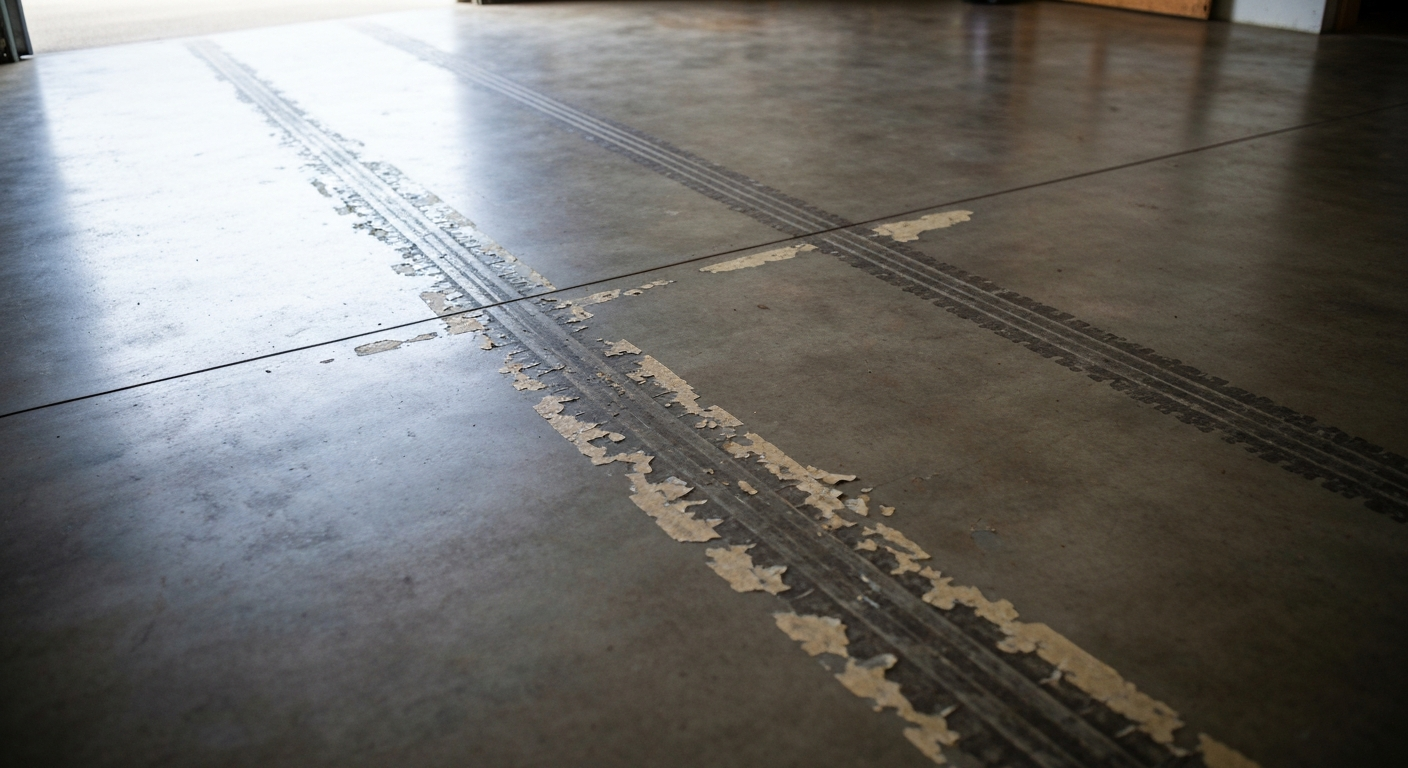
The clearest signs a garage floor needs recoating are peeling, hot-tire lift, fading or chalking, exposed bare spots, and a hazy or yellowed topcoat. Minor isolated damage may be repairable, but widespread adhesion failure, uneven wear, or moisture beneath the coating usually calls for a full recoat with proper surface preparation.
The condition of the coating underneath matters more than how quickly a fresh layer can be applied. Rolling new material over a weak or contaminated finish may improve the appearance temporarily, but it does not correct the original bond failure.
Quick Answer: Five Warning Signs
A coated garage floor may be due for repair or recoating when it shows:
- Peeling or delamination
- Hot-tire pickup
- A dull, chalky, or faded finish
- Chips, scratches, or bare concrete
- Hazing, yellowing, or cloudiness
A small stable defect may need only a localized repair. Damage across multiple areas, especially where the coating is lifting from the slab, generally requires broader preparation and recoating.
What Does Recoating a Garage Floor Mean?
Recoating is the process of restoring an existing coated floor rather than covering it with ordinary floor paint. Depending on the floor's condition, the work may involve cleaning, mechanical abrasion, grinding, removal of failed material, crack treatment, a new color or flake layer, and a compatible protective topcoat.
A recoat is not always a complete removal of the original system. If the existing coating is firmly bonded and compatible with the new material, it may be possible to mechanically abrade and re-topcoat it.
When the original coating is peeling, contaminated, moisture-affected, or poorly bonded, the failed material needs to be removed. The new system must bond to a sound surface rather than to a layer that is already separating.
1. Peeling or Delamination
Peeling is one of the strongest indications that a garage floor coating has lost adhesion.
The edges may begin curling upward, or sheets of coating may release from the concrete. In other cases, the floor may appear intact but sound hollow when tapped because the coating has separated underneath.
What Peeling Means
Delamination means the coating is no longer securely bonded to the slab or to a previous coating layer. Common causes include:
- Inadequate mechanical preparation
- Oil, dust, curing compounds, or old sealer left on the surface
- Moisture moving through the slab
- Application over weak surface paste
- An incompatible coating underneath
- Incorrect application temperature
- Insufficient cure time
- General wear and age
Moisture is especially important. Water vapor moving through the slab can place pressure beneath a coating, but visible peeling does not automatically prove that moisture is the only cause. Adhesion testing and inspection of the exposed surface help identify whether the failure occurred within the coating, between coating layers, or directly at the concrete.
Spot Repair or Full Recoat?
A small isolated peel caused by an impact or a localized contamination point may be repairable. The loose material must be removed back to a firmly bonded edge, and the exposed area must be properly prepared before patching.
A full recoat is more likely when:
- Peeling appears in several locations
- Large sections sound hollow
- The coating releases in sheets
- Failure continues beyond the visible edge
- Moisture is present beneath the film
- The original surface preparation was inadequate
Applying another topcoat over delaminated material will not restore the bond to the slab.
2. Hot-Tire Pickup or Tire Lift
Hot-tire pickup occurs when a vehicle tire sticks to the coating and pulls part of it away from the floor. It often appears as curved or rectangular bare areas where the tires normally rest.
Why Warm Tires Can Pull Up a Coating
Tires heat during driving. After the vehicle is parked, the rubber remains warm and presses against the coated surface. Softer, under-cured, thin, or poorly bonded materials may temporarily soften or adhere to the tread.
When the vehicle moves again, the tire can lift the coating.
Hot-tire failure is more likely when:
- The original product was not intended for vehicle traffic
- The coating was applied too thinly
- The slab was not mechanically profiled
- A previous sealer or contaminant remained
- The coating did not cure fully before vehicle use
- Installation temperatures slowed or disrupted curing
- The system has softened or degraded with age
Why Polyaspartic Systems Are Often Considered
Properly selected and installed polyaspartic systems are commonly used for garage floors because they can provide good abrasion resistance, chemical resistance, and hot-tire performance. They also cure more quickly than many traditional epoxy systems.
That does not mean every polyaspartic product will perform the same way. Preparation, coating thickness, material compatibility, slab temperature, and cure conditions still control the result. A strong product applied over a weak or contaminated surface can still fail.
Spot Repair or Full Recoat?
One stable tire-lift area may be repaired if the surrounding material is well bonded. Repeated pickup at multiple tires or parking locations suggests a broader system problem.
Before recoating, the existing finish should be checked for adhesion beyond the visibly damaged areas. If the same weak layer remains underneath the rest of the floor, localized patches may only delay a larger failure.
3. A Dull, Chalky, or Faded Finish
A garage floor coating does not need to peel before it becomes worn out. Gradual loss of gloss, fading, and chalky residue can indicate that the protective top layer is breaking down.
What Causes a Coating to Lose Its Finish?
Common causes include:
- Tire and foot traffic
- Sand and grit abrasion
- Repeated cleaning
- Road-salt residue
- Chemical exposure
- Sunlight near open garage doors
- Thin or worn topcoat material
- Normal aging
Fine sand brought into a garage acts like abrasive material under tires, rolling toolboxes, and footwear. Over time, the finish may become uneven, with dull travel lanes and glossier areas along walls or beneath storage.
Some coating materials are also more sensitive to ultraviolet exposure than others. Areas near garage-door openings may fade or discolor differently from the back of the room.
What Chalking Looks Like
Chalking appears as a pale or powdery residue on the surface. It may transfer to a cloth, mop, or hand. This can indicate surface degradation, though cleaning residue should be ruled out before assuming the coating itself is failing.
A test area cleaned with a compatible product can help determine whether the haze is removable contamination or deterioration of the finish.
Spot Repair or Full Recoat?
Uniform dullness with a firmly bonded coating may be a good candidate for cleaning, abrasion, and a new compatible topcoat.
A full decorative recoat may be preferable when the floor has:
- Uneven color across large areas
- Worn-through travel lanes
- Multiple patches
- Exposed flake or base coat
- A finish that cannot be restored by cleaning
Re-topcoating before the decorative layer wears through can sometimes reduce the amount of removal and rebuilding required.
4. Chips, Scratches, and Bare Spots
Dropped tools, jack stands, snowblower blades, dragged equipment, and sharp metal edges can damage even a durable garage coating.
Small scratches may be cosmetic. Deep chips and bare spots are more important because they expose the concrete or lower coating layers.
Why Exposed Concrete Matters
An exposed area can absorb:
- Snowmelt
- Road brine
- Oil
- Cleaning water
- Automotive chemicals
- Dirt and fine grit
Once contamination enters the exposed concrete, future repair can become more difficult. Moisture may also move beneath the edge of the surrounding coating if the damage is left open.
The exposed area does not automatically mean the entire floor has failed. The question is whether the damage came from a single impact or from a coating that has become brittle, thin, or poorly bonded throughout.
Spot Repair or Full Recoat?
A localized impact chip with solid surrounding edges is often a spot-repair candidate. The area should be opened to sound material, mechanically prepared, cleaned, and rebuilt with compatible products.
A broader recoat may make more sense when:
- Bare spots appear throughout the garage
- Scratches expose the base layer across traffic lanes
- Flake coverage is wearing away
- Edges continue to break after minor impacts
- Previous repairs create an uneven patchwork
- The topcoat is thin across most of the floor
Spot repairs may remain slightly visible, especially on solid-color or metallic finishes. Decorative flake systems can sometimes disguise localized repairs more effectively, but an exact match is not guaranteed.
5. Hazing, Yellowing, or Cloudiness
A cloudy or yellowed coating may indicate surface contamination, ultraviolet exposure, trapped moisture, chemical damage, or breakdown of the topcoat.
The appearance can range from a mild loss of clarity to white, milky patches beneath the film.
Possible Causes of Hazing
Cloudiness may result from:
- Moisture trapped during application
- Water moving beneath the coating
- Condensation during curing
- Incompatible cleaners
- Salt or soap residue on the surface
- Abrasion that scatters light
- An incompatible recoat
- Breakdown of the clear layer
Surface residue should be ruled out first. If cleaning does not remove the haze and it appears to be beneath the clear film, the coating may need to be abraded or removed.
Why Some Coatings Yellow
Some resin systems naturally amber with age or ultraviolet exposure. Yellowing may be more noticeable over white, light gray, or blue finishes and near garage doors where sunlight reaches the floor.
Yellowing is sometimes cosmetic. It becomes a stronger reason to recoat when it is uneven, accompanied by loss of gloss, or combined with peeling and wear.
Spot Repair or Full Recoat?
A localized cloudy area caused by a known spill may be repairable. Widespread yellowing or moisture-related haze generally requires broader evaluation.
Recoating without identifying the source may trap the same problem beneath a new layer.
Spot Repair vs. Full Recoat
The correct approach depends on the extent of damage and the condition of the coating that remains.
| Consideration | Spot repair | Full recoat |
|---|---|---|
| Best for | One or two isolated defects | Widespread wear, peeling, fading, or multiple failures |
| Existing adhesion | Surrounding coating is firmly bonded | Adhesion is inconsistent or uncertain |
| Appearance | A visible blend or patch may be acceptable | A more uniform finished appearance is needed |
| Preparation | Local grinding, feathering, and cleaning | Broad abrasion or grinding across the floor |
| Coating condition | Most of the system remains intact | The topcoat or decorative layer is worn across large areas |
| Moisture concern | No evidence of broader moisture problems | Moisture may be affecting several areas |
| Likely service value | Useful when the defect is truly isolated | More reliable when the system has reached general wear |
| Main limitation | Color and texture may not match perfectly | Higher cost and longer preparation process |
No responsible lifespan can be assigned from appearance alone. The result depends on substrate condition, surface preparation, product compatibility, traffic, winter exposure, and maintenance.
A Simple Diagnostic Process
Before deciding between a patch and a recoat, examine the floor in a consistent order:
- Clean a representative area. Remove salt film, dirt, grease, and soap residue so actual coating damage is visible.
- Mark every defect. Note peeling, tire lift, chips, bare spots, cloudy areas, and worn travel lanes.
- Check the edges. Determine whether loose material ends at a firm boundary or continues lifting.
- Look for patterns. Damage beneath every tire position suggests a different cause than one isolated tool impact.
- Inspect moisture-prone areas. Pay attention to the garage entrance, cracks, drains, low spots, and areas beneath parked vehicles.
- Compare high- and low-traffic zones. Uniform fading suggests age or surface wear, while isolated failures may indicate contamination or impact.
- Evaluate the slab itself. Settlement, moving cracks, scaling, and deep deterioration need to be addressed before selecting a coating repair.
Why Preparation Matters More Than the New Topcoat
A recoat is only as reliable as the layer beneath it.
If the existing coating is firmly bonded, it still needs to be cleaned and mechanically abraded so the new material can attach. Glossy surfaces generally do not provide enough profile for dependable adhesion without preparation.
If the coating is failing, grinding or other mechanical removal may be needed to reach sound material.
Proper preparation may include:
- Removing oil, salt, and chemical residue
- Grinding away loose or incompatible coatings
- Profiling sound existing material
- Feathering repair edges
- Treating stable cracks and damaged joints
- Correcting localized surface defects
- Checking moisture conditions
- Vacuuming fine dust
- Confirming material compatibility
Pressure washing alone does not create the same surface profile as mechanical grinding. It can clean contaminants and loose residue, but it does not reliably remove every bonded sealer, weak coating layer, or smooth finish.
Simply rolling a new product over a peeling floor may hide the damage briefly. The weak layer remains underneath and can release with the new coating attached to it.
The Flathead Valley Wear Cycle
Garage coatings in Kalispell and the surrounding Flathead Valley face a combination of winter and seasonal conditions that can accelerate wear.
Snowmelt and Road Brine
Vehicles carry snow and de-icing residue into the garage. As the material melts, salty water can remain beneath tires or collect in low areas.
A sound topcoat helps separate that moisture from the slab, but scratches and bare spots create direct entry points. Salt residue should be removed rather than allowed to accumulate through the season.
Sand and Grit Abrasion
Road sand and fine gravel become abrasive beneath vehicle tires, boots, tool carts, and storage equipment. This repeated grinding action can dull the finish and wear down textured high points.
Routine sweeping is one of the simplest ways to reduce that abrasion.
Temperature Swings
Unheated and semi-heated garages can experience large temperature changes. The slab may remain cold even when warm air enters, leading to condensation or slower drying.
Temperature also affects coating installation. The air may feel warm enough while the concrete remains outside the material's acceptable application range. Recoating schedules should account for slab temperature, overnight lows, moisture, and cure time.
Freeze-Thaw Exposure Near the Door
Moisture near the garage entrance may freeze and thaw as the door opens, sunlight reaches the threshold, and outdoor temperatures change. Existing chips or delaminated edges can become worse when water enters beneath them.
A coating cannot stop slab movement or correct drainage, but keeping the finish intact reduces direct exposure.
Streamline Solutions' Take
"A floor should be recoated before normal wear becomes widespread delamination. When the coating is still firmly bonded, a properly prepared re-topcoat may restore protection without rebuilding the entire system. When peeling, moisture, or hot-tire lift appears in several areas, the failed layer needs to be removed rather than covered."
– Streamline Solutions, Kalispell, MT
How Streamline Solutions Can Help
Streamline Solutions evaluates and restores existing coated garage floors throughout the Flathead Valley. Depending on adhesion, wear, moisture exposure, and slab condition, the appropriate work may include garage floor resurfacing and recoating, broader concrete coating services, professional surface preparation before recoating, or a compatible polyaspartic floor coating. General preparation, curing, and maintenance information is also available in the frequently asked questions.
Frequently Asked Questions
Restore the Coating Before Failure Spreads
Peeling, hot-tire lift, fading, bare spots, and cloudiness are not all the same problem. Some are normal signs of topcoat wear, while others indicate that the bond beneath the system has failed.
An early inspection can separate a manageable spot repair or re-topcoat from a floor that needs broader removal and resurfacing. The reliable approach is to fix the cause, prepare the remaining surface, and apply a compatible system—not simply cover the warning signs.
For an assessment of an existing coated garage floor in the Flathead Valley, contact Streamline Solutions at 406-909-4342.
Related Guides & Services
Garage Floor Resurfacing
Learn how we remove failed coatings and restore damaged garage slabs.
Concrete Coating Services
Explore our full range of protective coatings for garages, shops, and patios.
Surface Preparation
See how proper preparation ensures your new coating bonds permanently.
Polyaspartic Floor Coatings
Fast-curing, UV-stable systems ideal for Montana's demanding conditions.
Frequently Asked Questions
Get clear answers on installation, curing, and maintaining your coated floor.
Ready to fix a failing floor?
Get a free, fixed-price quote from the Flathead Valley's Concrete Surface Protection Specialists.
