
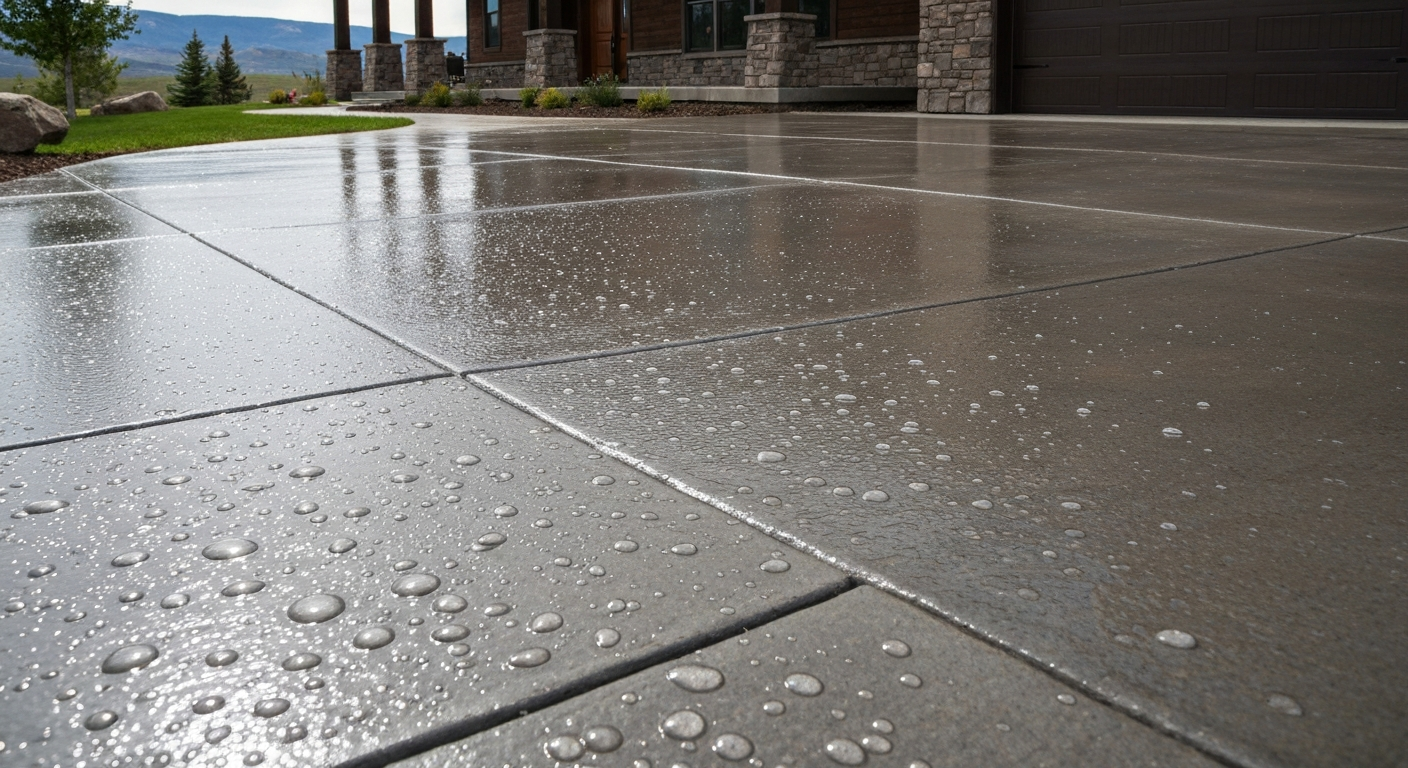
For most properties, the answer to how often to seal a concrete driveway is every two to five years, depending on the sealer, traffic, preparation, and exposure. In Montana, annual inspection is wise: a film-forming sealer may need attention every one to three years, while a quality penetrating sealer may remain effective for roughly three to seven years.
Road deicers, repeated freeze-thaw cycles, plowing, snowmelt, and seasonal temperature changes can shorten those intervals. The right time to reseal is determined by surface condition and water repellency—not the calendar alone.
Quick Answer: Key Takeaways
- Inspect a Montana driveway every spring after the main freeze-thaw season.
- Expect many film-forming sealers to need recoating about every one to three years on exposed driveways.
- Expect many penetrating sealers to provide roughly three to seven years of protection, depending on chemistry and application.
- Reseal when water begins soaking in rather than beading, the finish wears unevenly, or the surface becomes harder to clean.
- Sealing slows moisture and chloride intrusion. It does not repair weak concrete, stop slab movement, or make the driveway immune to winter damage.
How Often to Seal a Concrete Driveway by Sealer Type
The word "sealer" covers several different products. Some remain mostly below the surface and repel water without changing the appearance. Others create a visible film that adds gloss, deepens color, and takes the direct wear from tires and snow-clearing equipment.
That difference has a major effect on resealing frequency.
| Factor | Penetrating sealer | Film-forming sealer |
|---|---|---|
| How it works | Enters the pores and creates water-repellent protection within the concrete | Forms a protective acrylic, polyurethane, or similar layer over the surface |
| Typical appearance | Natural or nearly invisible | Satin, wet-look, or glossy |
| Practical reseal range | Often about 3–7 years | Often about 1–3 years on an exposed driveway |
| Traction | Usually retains the original surface texture | May become smoother; traction additive may be needed |
| Breathability | Generally allows more vapor movement | Varies; a heavy or improperly applied film may trap moisture or turn cloudy |
| Winter wear | Not directly scraped away as quickly because protection is below the surface | Surface film can wear from tires, grit, shovels, and plowing |
| Color enhancement | Little or none | Can darken concrete and enhance decorative color |
| Best fit | Broom-finished Montana driveways exposed to snow, salt, and freeze-thaw | Decorative or exposed-aggregate surfaces where appearance is a priority |
These ranges are planning estimates rather than guarantees. PROSOCO lists a service life of approximately five to seven years for certain protective water-repellent treatments, while topical products may require more frequent maintenance as their exposed film wears.
The actual interval depends on the exact product. A low-solids acrylic is not comparable to a deeply penetrating silane treatment, even when both containers use the word "sealer."
Penetrating Sealers for Montana Driveways
Penetrating sealers are commonly based on silane, siloxane, or a blend of the two. They enter the capillary structure of the concrete and create a hydrophobic—or water-repelling—zone without leaving a substantial surface coating.
A quality penetrating treatment can reduce the entry of:
- Liquid water
- Dissolved road salts
- Magnesium chloride residue
- Snowmelt
- Other waterborne contaminants
Manufacturers formulate penetrating silane and siloxane products specifically to reduce moisture and chloride intrusion while preserving the concrete's natural appearance and vapor permeability.
Advantages
- Retains the original broom-finished appearance
- Usually does not create a glossy or plastic-looking surface
- Preserves more of the concrete's original traction
- Does not peel in the same way a surface film can
- Offers useful protection from water and chloride intrusion
- Generally suits working driveways exposed to snow and plowing
- Often requires less frequent reapplication than an acrylic film
Limitations
- Does not hide stains, pitting, or discoloration
- Does not make the driveway look newly coated
- Provides limited resistance to oil staining compared with some topical systems
- Cannot repair scaling or weak surface paste
- May absorb unevenly if an old sealer remains
- Requires a sufficiently porous, clean, and dry surface
For a standard broom-finished driveway in the Flathead Valley, a penetrating sealer is often the practical default. It provides winter-oriented protection without creating a film that must absorb direct plow, tire, and traction-sand wear.
Film-Forming Sealers for Driveways
Film-forming sealers leave a visible layer over the concrete. Acrylic is common on residential exterior surfaces, while some higher-performance systems use polyurethane or other resin types.
These products may:
- Deepen the concrete color
- Add satin or gloss
- Make stains easier to clean
- Reduce surface dusting
- Protect decorative color
- Create a replaceable wear layer
Topical sealers can be appropriate for decorative concrete or exposed aggregate where appearance matters. Exterior acrylic products are commonly designed to reduce staining and the effects of deicing-salt exposure.
Advantages
- Enhances color and decorative detail
- Provides a visible finish
- Can improve resistance to surface staining
- Makes many spills easier to clean
- Can be renewed before the underlying concrete is exposed
Limitations
- Wears directly beneath tires and snow-removal equipment
- May become slippery when wet or icy
- Can whiten, bubble, flake, or peel if overapplied
- May trap visible moisture if installed on damp concrete
- Requires compatibility testing before recoating
- Usually needs maintenance more often than a penetrating treatment
Traction deserves special attention on a Montana driveway. A glossy product can become slick when wet, snowy, or icy. Film-forming systems may require an appropriate traction additive, although that does not eliminate the hazards created by winter conditions.
Seven Signs It Is Time to Reseal
A driveway should be evaluated before applying another coat. These signs indicate that protection may be wearing down or that the concrete needs further attention.
1. Water no longer beads
A recently treated surface usually causes water to form beads or shallow droplets. When water spreads and begins soaking in quickly, the repellent effect may be declining.
2. The concrete darkens immediately when wet
Unsealed or weakly protected concrete often becomes noticeably darker as it absorbs water. Some darkening is normal, but rapid, uniform absorption suggests reduced repellency.
3. The finish looks dull or patchy
Film-forming sealers wear along tire paths, turning areas, and the driveway entrance. A finish that remains glossy near the edges but looks bare in the center may be approaching its maintenance point.
4. Winter residue has become harder to remove
When chloride deposits, dirt, oil, and tire marks begin soaking in rather than remaining near the surface, the protection may be reduced.
5. The surface is beginning to dust
Light dusting may indicate surface wear, but it can also signal weak concrete. Sealer may reduce dusting in some cases, but a soft or deteriorating surface should be evaluated before more material is applied.
6. Small pits or flakes are appearing
Early pitting and scaling deserve attention. A penetrating sealer may help slow further moisture and chloride exposure, but it cannot rebond material that has already separated.
7. The previous film is peeling, whitening, or flaking
These are not signs to apply another coat immediately. They may indicate excess film thickness, trapped moisture, incompatibility, or poor preparation. Failed material may need to be removed before resealing.
The Simple Water-Bead Test
A homeowner can perform a basic screening test with clean water. This does not replace product records or a full inspection, but it helps show how the surface currently handles moisture.
- Choose several locations. Test a tire path, the driveway entrance, a shaded area, and a protected edge.
- Clean away dirt and salt. The test area should be free of dust, oil, and residue that could change how the water behaves.
- Let the surface dry. Do not test immediately after washing or snowmelt.
- Pour a small amount of water onto each area. A few tablespoons are enough.
- Watch for several minutes. Effective water repellency should cause the water to bead, remain on the surface, or absorb slowly.
- Compare the locations. Rapid darkening in tire paths but not at the edges suggests uneven wear.
- Repeat after the main winter season. A spring test provides a useful picture after months of snow, grit, and deicer exposure.
Some penetrating-sealer data sheets recommend reapplication when water no longer beads on the concrete.
A failed bead test does not automatically mean the same product should be applied again. The existing sealer chemistry and concrete condition should be identified first.
What Shortens the Resealing Interval?
Heavy vehicle traffic
Turning tires and repeated braking wear topical films more quickly than straight travel. The entrance and normal parking paths usually lose protection first.
Snowplows and metal-edged equipment
A blade set too low can scrape film-forming sealer and damage the concrete itself. Rubber or polymer cutting edges may be less aggressive, but equipment still needs proper adjustment.
Traction sand and road grit
Grit acts as an abrasive beneath tires. Regular sweeping reduces wear on both sealed and unsealed concrete.
Road deicers
Montana uses magnesium chloride and sodium chloride as winter-maintenance materials. Vehicles can carry that residue onto residential driveways through tires, undercarriages, and melting snow.
A penetrating chloride screen is often useful in these conditions, but residue should still be rinsed away during suitable weather rather than left to concentrate repeatedly.
Strong sun exposure
Ultraviolet exposure and summer heat gradually weather topical products. South- and west-facing areas may lose sheen faster than shaded sections.
Poor preparation
Dirt, oil, curing compounds, old coatings, moisture, and incompatible sealer can prevent proper penetration or adhesion.
Applying too much material
More sealer is not always more protection. Heavy topical coats can bubble, remain soft, turn white, peel, or trap moisture. Manufacturer guidance warns that puddling and excessive film buildup can cause whitening, flaking, and failure.
Weak or damaged concrete
A sealer can only remain attached to the material beneath it. If weak surface paste separates, a topical film may leave with it.
The Montana and Flathead Valley Angle
Freeze-thaw exposure increases the value of water repellency
Freeze-thaw damage occurs when moist concrete experiences repeated freezing and thawing. The risk increases as concrete approaches critical moisture saturation, and deterioration may develop internally or as surface scaling.
A penetrating treatment helps by reducing liquid-water entry. It cannot eliminate every source of moisture or correct poor drainage beneath the driveway.
Road salt and magnesium chloride increase chloride exposure
Magnesium chloride and sodium chloride help prevent or remove ice from Montana roads. That same winter residue reaches driveways on vehicles and snow-removal equipment.
Chloride exposure and freeze-thaw cycling can contribute to surface deterioration, especially when concrete already contains weak surface material or remains wet for long periods.
Heavy snow creates repeated wetting
Snowbanks along a driveway can melt and refreeze repeatedly. Low areas, cracks, and joints may remain wet longer than the open center of the slab.
Sealing may reduce absorption from above, but grading and drainage still matter. Downspouts should not discharge onto the driveway where water can collect and refreeze.
Plowing creates mechanical wear
Film-forming products sit directly in the path of snow-removal equipment. A penetrating sealer usually handles this condition more naturally because it does not rely on a continuous exposed film.
Damage from an improperly adjusted blade remains possible with either type.
The application season is limited
Exterior sealer needs a clean, dry surface and suitable temperatures during application and cure. Products commonly prohibit installation over frozen concrete, standing water, or when rain or heavy fog is expected soon after application.
In the Flathead Valley, a workable window can be shortened by overnight frost, spring moisture, irrigation, smoke-season scheduling, and rapid fall temperature changes. The slab—not only the air—must be dry and within the product's acceptable range.
How to Prepare a Driveway for Resealing
Preparation depends on the existing sealer and surface condition, but a sound process generally includes:
- Identify whether the driveway has a penetrating or film-forming product.
- Check compatibility with the proposed sealer.
- Remove dirt, winter deposits, oil, moss, and organic staining.
- Repair appropriate cracks and damaged areas.
- Remove loose or failed topical sealer where necessary.
- Rinse away cleaning residue.
- Allow the concrete to dry fully.
- Confirm surface and weather conditions.
- Test the product in an inconspicuous area.
- Apply at the manufacturer's stated coverage rate.
Cleaning is essential, but pressure should be controlled. Excessively aggressive washing can remove weak surface material or leave visible wand marks.
When Sealing Should Wait
Postpone resealing when:
- The concrete is damp or frozen.
- Rain, frost, or heavy dew is expected during cure.
- A previous coating is peeling or cloudy.
- The driveway is actively scaling.
- Cracks show vertical displacement or continued movement.
- Oil or silicone contamination remains.
- The existing sealer cannot be identified.
- Drainage leaves standing water on the surface.
- The concrete is too new for the selected product.
Resealing is maintenance, not camouflage. Existing damage should be understood before it is covered.
Streamline Solutions Take
"For most broom-finished driveways in the Flathead Valley, a quality penetrating silane or siloxane treatment is the practical choice. It reduces water and chloride intrusion without adding a film that must withstand direct plow and tire wear. Inspect the driveway every spring, use the water-bead test, and reseal based on actual performance rather than applying another coat automatically."
- Streamline Solutions, Kalispell, MT
How Streamline Solutions Can Help
Streamline Solutions protects and maintains existing exterior slabs throughout the Flathead Valley. Property owners can review the main concrete sealing service, learn about the driveway sealing process, or explore winter concrete protection for surfaces exposed to snow, moisture, and road residue. When cleaning is required before treatment, information is available through concrete pressure washing and the frequently asked questions.
Frequently Asked Questions
Related Guides & Services
Concrete Sealing
Professional sealing services to protect Flathead Valley concrete from freeze-thaw and salt.
Driveway Sealing
Deep-penetrating silane/siloxane protection specifically for working Montana driveways.
Winter Protection
Pre-winter strategies to defend your concrete from snowmelt, ice, and road salt.
Concrete Pressure Washing
The essential prep step: removing grime, salt residue, and oil before sealing.
Frequently Asked Questions
Answers to common questions about sealing, coating, and protecting Flathead Valley concrete.
Ready to protect your driveway before winter?
Get a free, no-pressure estimate for professional concrete sealing in Kalispell and the Flathead Valley.
