
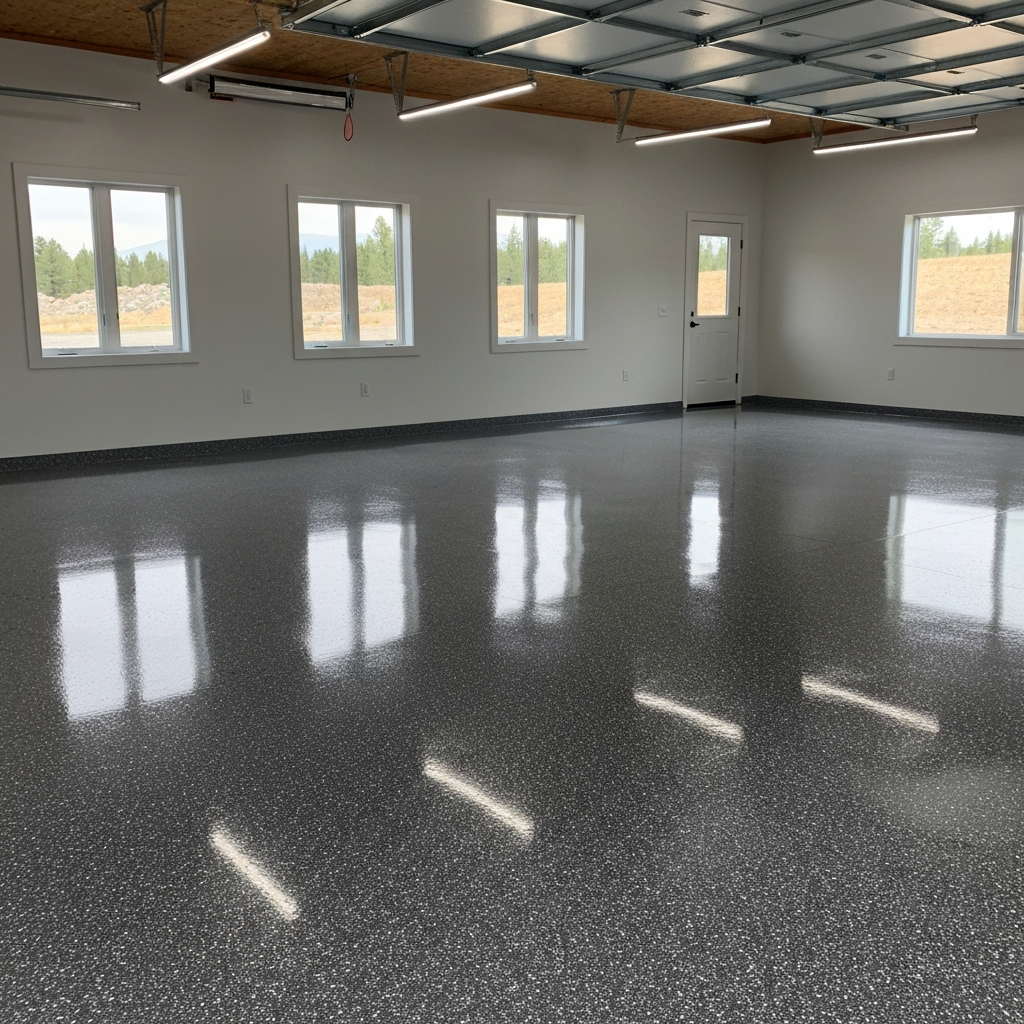
When comparing garage floor coating vs mats vs tiles, the bottom-line decision is whether the floor needs temporary coverage or a long-term surface bonded directly to the slab. Mats and tiles can be practical for renters, limited budgets, or quick installations, but a properly prepared epoxy or polyaspartic coating usually provides the strongest long-term combination of moisture control, cleanability, appearance, and cost per year.
That advantage matters in Montana, where vehicles bring snow, road salt, grit, and slush into the garage for months at a time.
Quick Answer: Which Garage Floor Option Is Best?
Bonded coating: Best for long-term protection, seamless cleaning, and Montana garages exposed to slush and road salt.
Roll-out or parking mats: Best for temporary coverage, renters, and targeted protection beneath a vehicle.
Peel-and-stick or interlocking tiles: Best for fast visual improvement, removable installations, and slabs where a permanent coating is not practical.
The lowest upfront price is not always the lowest long-term cost. Replacement, movement, trapped moisture, damaged seams, and cleaning difficulty can change the value of mats and tiles over time.
Garage Floor Options at a Glance
The three categories solve different problems.
A bonded floor coating adheres directly to properly prepared concrete. Epoxy, polyaspartic, and related systems may include a pigmented base, decorative flakes, and a protective top coat.
A roll-out mat sits on top of the slab without becoming part of it. Some mats cover only a parking area, while others can be cut to cover most of the garage.
Peel-and-stick tiles use adhesive to attach individual pieces to the floor. Interlocking tiles connect mechanically and usually float over the slab without adhesive.
Garage Floor Coating vs Mats vs Tiles: Comparison Table
| Factor | Bonded epoxy or polyaspartic coating | Roll-out or parking mats | Peel-and-stick or interlocking tiles |
|---|---|---|---|
| Durability | Strong when the slab is sound and preparation is correct | Varies by thickness and material; edges may curl, shift, or wear | Varies widely; seams, locks, or adhesive can become weak points |
| Expected service value | Designed as a long-term finish rather than temporary coverage | Often temporary or replaceable | Usually between temporary coverage and a permanent finish |
| Upfront cost | Highest because preparation and installation are substantial | Usually the lowest for partial coverage | Moderate, depending on material and garage size |
| Cost over time | Often favorable because the system is bonded and does not need frequent repositioning or replacement | Can rise if mats deform, stain, shift, or need replacement | Can rise when damaged pieces, adhesive failure, or moisture issues require repair |
| Appearance | Seamless and consistent; available in solid, flake, and decorative systems | Functional but may look separate from the garage | Can create patterns, borders, or a modular finished look |
| Cleaning | Usually straightforward because there are no open seams beneath the finish | Surface is easy to wipe, but dirt and liquid can reach the edges or underside | Debris and liquid can collect at seams or beneath floating tiles |
| Moisture behavior | Bonded to the slab, so there is no open space beneath it for slush to collect | Water can migrate under edges and remain against the concrete | Moisture can enter through seams and collect beneath tiles |
| Road-salt exposure | Suitable systems can resist routine slush and salt exposure when maintained properly | Saltwater may sit under the mat where it is difficult to see | Salt residue can accumulate in seams or beneath the tile system |
| Hot-tire behavior | Depends on material selection, preparation, and curing; suitable systems are designed for vehicle use | Some mats soften, wrinkle, or discolor | Some adhesives or tile materials may react to heat or tire pressure |
| Removal | Difficult because the finish is bonded to the concrete | Easy | Interlocking tiles are easy to remove; adhesive tiles may leave residue |
| Installation demands | Requires mechanical preparation, suitable temperatures, and controlled curing | Fast and relatively simple | Faster than coating, but layout and slab condition still matter |
| Best fit | Long-term owner-occupied garages and active workspaces | Renters, temporary protection, or a limited parking zone | Modular design, quick installation, or a removable finished surface |
Option 1: Bonded Garage Floor Coatings
A bonded system is applied directly to prepared concrete. The key word is bonded. It does not simply rest on top of the slab.
Depending on the selected system, installation may include:
- Mechanical surface preparation
- Cleaning and treatment of cracks or surface defects
- Application of a base coat
- Optional decorative flake broadcast
- Removal of loose or raised flakes
- Application of a protective top coat
- Controlled curing before foot and vehicle traffic
Epoxy is often used for its build, adhesion, and decorative flexibility. Polyaspartic materials are frequently selected where faster return to service, UV stability, or specific performance characteristics are priorities. Product chemistry and installation details vary, so the terms should not be treated as interchangeable.
Advantages of a Bonded Coating
- Creates a seamless, finished surface
- Prevents slush from flowing beneath a loose floor covering
- Simplifies sweeping, mopping, and salt-residue removal
- Offers solid-color, flake, and other decorative options
- Can be configured for additional texture and traction
- Handles vehicle traffic when the correct system is installed and cured
- Often delivers strong value over a longer ownership period
Limitations of a Bonded Coating
- Costs more upfront than a basic mat
- Depends heavily on surface preparation
- Requires the slab to be suitable for coating
- Needs controlled temperature and moisture conditions during installation
- Requires curing time before normal use
- Cannot stabilize major slab movement or structural failure
- May show cracks again if the underlying concrete continues to move
A coating is not a shortcut around slab problems. Oil contamination, moisture vapor, weak surface paste, existing coatings, active cracks, and deep deterioration need to be identified before installation.
Best For
A bonded coating is usually the strongest fit for a property owner who plans to keep and use the garage, wants a finished appearance, and needs a surface that can be cleaned after Montana winter exposure.
Option 2: Roll-Out and Parking Mats
Garage mats are available as individual parking pads or wider rolls intended to cover a larger portion of the floor. They provide immediate coverage without grinding, coating, or curing.
A mat can protect the area directly beneath a vehicle from oil drips, muddy tires, and winter slush. It can also make sense when the property is rented or the floor cannot be permanently altered.
Advantages of Garage Mats
- Low initial cost for a limited area
- Quick installation
- No coating cure time
- Easy to remove or take to another property
- Useful for catching drips under a specific vehicle
- Can cover stains or an unattractive slab temporarily
Limitations of Garage Mats
- Edges may curl, move, or become trip points
- Dirt and liquid can migrate underneath
- Trapped moisture may remain hidden
- Salt residue can build up beneath the mat
- Some materials can expand, contract, wrinkle, or stiffen with temperature changes
- Large mats may be awkward to lift for cleaning
- Floor drains and thresholds can complicate placement
- Tires or turning forces may shift lighter materials
A mat does not seal the slab. It covers the concrete while leaving an interface where water and debris can collect.
Best For
Mats are practical for renters, short-term use, targeted protection beneath a vehicle, or a garage where permanent installation is not allowed. They work best when the mat can be lifted regularly so the slab and underside can be cleaned and dried.
Option 3: Peel-and-Stick and Interlocking Tiles
Garage tiles create a modular surface from individual pieces. Peel-and-stick products rely on adhesive, while interlocking products connect at their edges and float over the slab.
Tiles can quickly change the appearance of a garage. Different colors may be combined into borders, parking areas, work zones, or patterns.
Advantages of Garage Tiles
- Fast visual improvement
- Wide range of colors and patterns
- Individual damaged interlocking pieces may be replaceable
- Floating tiles can be removed
- Installation can often proceed in sections
- Some tile profiles allow limited airflow or drainage beneath the surface
Limitations of Garage Tiles
- Every tile introduces seams
- Water, dirt, and salt may pass through or collect at joints
- Floating tiles may click, shift, or feel uneven over an irregular slab
- Adhesive products need a clean, stable surface
- Moisture can weaken some adhesives
- Hot tires may affect certain materials or adhesive systems
- Salt residue beneath the floor can be difficult to clean
- Damaged locks or lifting corners can create uneven areas
Peel-and-stick tiles are especially dependent on slab preparation. Dust, oil, moisture, weak concrete, or old coatings can reduce adhesive performance. Interlocking tiles are less dependent on adhesion, but the slab still needs to be reasonably flat and stable.
Best For
Tiles make sense when fast installation, modular design, or future removal is more important than a seamless floor. They can also work in dry workshops or display spaces where vehicle slush is limited and the underside can be inspected.
Why Upfront Price Does Not Tell the Whole Story
A basic mat may cost less at the start, but the useful comparison is total cost over the period the floor will be used.
Long-term costs may include:
- Replacement materials
- Shipping or disposal
- Reinstallation
- Cleaning beneath the surface
- Repair of lifted edges or damaged seams
- Adhesive removal
- Lost use of the garage
- Moisture-related staining or odor
- Repeated cosmetic upgrades
A coating carries more preparation and installation cost at the beginning. When properly matched to a sound slab, it does not need to be repositioned after cleaning, lifted to dry the concrete, or assembled from individual pieces.
That does not mean every coating automatically lasts longer than every mat or tile. Coating performance depends on preparation, product selection, application, curing, use, and the condition of the slab. A poorly prepared coating can fail early, while a quality mat in a clean, dry garage may perform adequately for years.
The more useful conclusion is that a properly installed coating tends to offer the best long-term cost per year for an owner who needs a permanent garage finish.
Maintenance and Cleaning
Maintenance differs substantially among the three options.
Cleaning a Bonded Coating
A seamless coated floor can generally be swept, vacuumed, or cleaned with a compatible mild cleaner. Meltwater and salt residue remain visible on top rather than disappearing beneath loose material.
The floor should still be maintained. Grit can act like an abrasive under tires and footwear, while standing salty water can stain or stress many materials over time.
Cleaning Beneath a Mat
The top of a mat may be easy to wipe, but the underside is often neglected. Meltwater can run beyond the vehicle's footprint, move through wrinkles, or enter around the perimeter.
The mat may need to be moved, rinsed, dried, and reinstalled. Large one-piece rolls can make that process inconvenient.
Cleaning Tile Systems
Tile surfaces can usually be swept or mopped, but seams create additional pathways. Floating tiles may need to be lifted periodically if water, road salt, or debris accumulates underneath.
Peel-and-stick tiles cannot be lifted for routine cleaning without risking adhesive damage. That makes proper sealing at the seams and moisture management especially important.
The Montana and Flathead Valley Factor
Garage floors around Kalispell and the Flathead Valley face conditions that make moisture behavior more important than it might be in a dry climate.
Vehicles Carry Winter Inside
Snow packs into tire treads, wheel wells, bumpers, and undercarriages. Once the vehicle enters the garage, that material melts and spreads beyond the tires.
The resulting water may contain:
- Road salt or brine
- Fine gravel
- Sand
- Soil
- Automotive residue
- Ice-melt chemicals
A loose covering can hide that mixture underneath. A bonded coating keeps it on the visible, cleanable side of the floor.
Cold Slabs Dry Slowly
An unheated garage slab may remain cold even when the air briefly warms. Water trapped beneath a mat or tile system can dry slowly, especially when airflow is limited.
That does not guarantee damage, but it makes regular inspection and drying more important.
Freeze-Thaw Exposure Can Continue Near the Door
The area near a garage door may experience changing temperatures as outside air enters, sunlight warms the threshold, and snowmelt refreezes. Water held at seams or under edges may remain in contact with the concrete through repeated temperature changes.
A floor covering cannot correct a drainage problem or prevent the slab itself from moving. However, eliminating a loose space where salty water can remain hidden is a practical advantage of a bonded system.
Road Salt Needs to Be Removed
A coating does not make road salt harmless. Slush and residue should still be removed rather than left on the floor for weeks.
The difference is accessibility. A visible, seamless surface makes it easier to identify and clean the affected area.
Coating Performance Still Depends on Preparation
The strongest argument for coating only applies when installation is handled correctly.
The slab should be evaluated for:
- Moisture behavior
- Existing sealers or coatings
- Oil and chemical contamination
- Surface strength
- Cracks and joint movement
- Spalling or scaling
- Drainage and low areas
- Previous patching
- Temperature during installation
Mechanical preparation creates a suitable profile and removes weak or incompatible material. Simply applying a coating over smooth, dirty, sealed, or deteriorated concrete can lead to peeling or delamination.
Curing also matters. Foot traffic, stored items, and vehicle tires should not return until the selected system has reached the appropriate stage of cure. Cooler slab temperatures may affect that schedule.
Streamline Solutions' Take
"For a rented garage or a short-term need, a removable mat or interlocking tile system can be reasonable. For an owner-occupied garage that regularly receives Montana snow, salt, and slush, a properly prepared bonded coating is usually the more practical long-term surface because it eliminates open seams and hidden space beneath the finish."
– Streamline Solutions, Kalispell, MT
How Streamline Solutions Can Help
Streamline Solutions evaluates and coats existing garage floors throughout the Flathead Valley. Depending on slab condition, use, appearance goals, and the available installation window, the appropriate option may include broader concrete coating services, a prepared epoxy garage floor, or a polyaspartic floor coating. Property owners comparing thin floor paint with a bonded system can also review the guide to concrete coating vs paint, while preparation and service questions are addressed in the frequently asked questions.
Frequently Asked Questions
Related Guides & Services
Concrete Coating Services
Professional epoxy and polyaspartic coating systems for Montana properties.
Read the guideEpoxy Garage Floors
Durable, prepared epoxy base systems for stable interior garages.
Read the guidePolyaspartic Floor Coatings
Fast-curing, UV-stable topcoats for high-exposure and sunny garages.
Read the guideConcrete Coating vs Paint
Why thin DIY floor paint peels and fails in Montana garages.
Read the guideFrequently Asked Questions
Answers to common questions about preparation, curing, and maintenance.
Read the guide
Have a Concrete or Paver Project in the Flathead Valley?
Get an honest evaluation and a fixed-price quote from Kalispell's surface protection specialists.
