
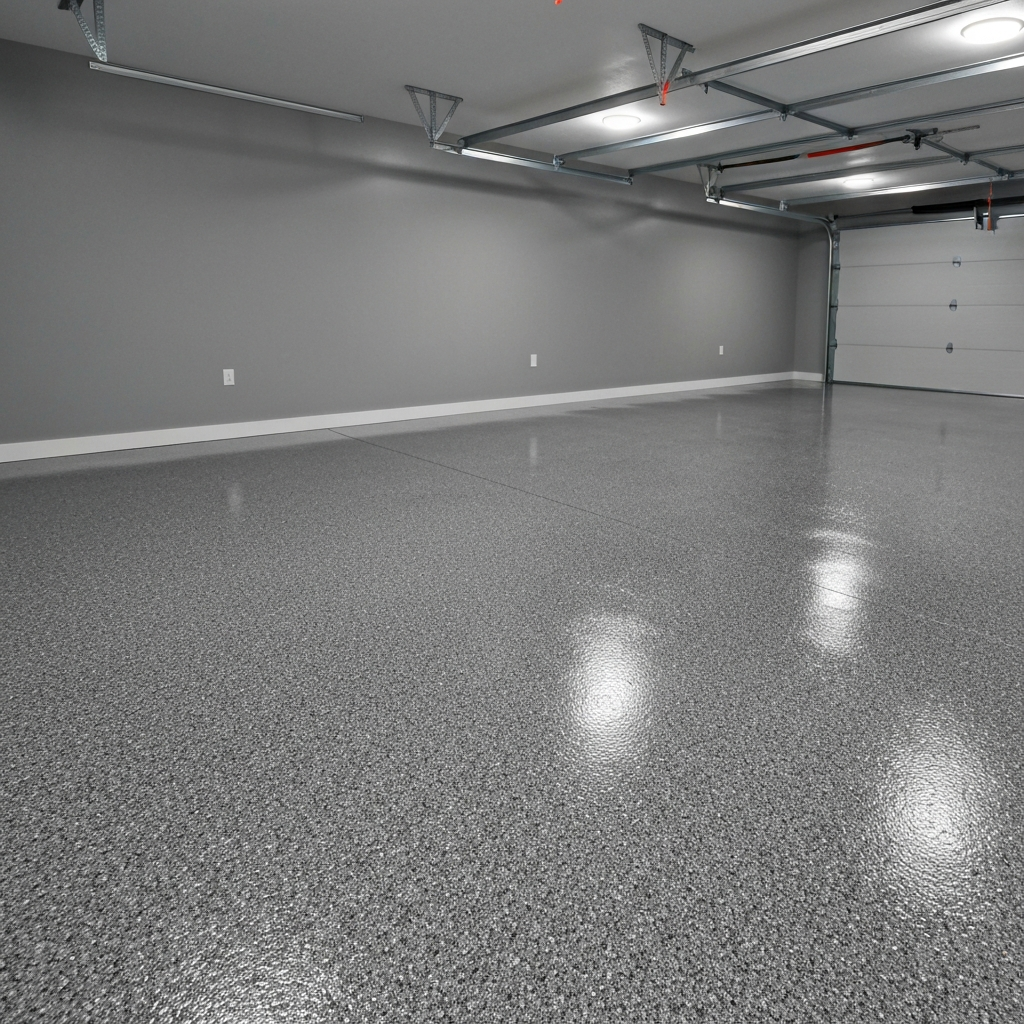
A useful garage floor flake color guide should do more than list attractive combinations. The right blend needs to work with the garage's walls, cabinets, lighting, vehicle use, and the amount of dirt, road grime, and winter slush the floor will see.
Flake flooring creates its finished appearance through a combination of the base-coat color, the vinyl chip blend broadcast into that coat, and the clear protective top coat. Choosing well means balancing appearance, texture, maintenance, and how much of the existing slab needs to be visually softened.
Quick Answer: Choosing a Flake Blend
"A flake garage floor uses a prepared base coat, decorative vinyl chips broadcast across the wet coating, and a clear protective top coat. The base color establishes the background, while the chip colors, chip size, and broadcast density determine how subtle, textured, or visually active the finished floor appears."
"For an easy-to-maintain Montana garage, medium neutral blends with several shades usually hide tracked-in dirt, minor discoloration, and salt residue better than very dark, very light, or nearly solid-color floors."
How Garage Floor Flake Systems Work
Decorative flakes are small, irregular vinyl chips made for broadcast coating systems. They are sometimes called color chips, floor chips, or broadcast flakes.
Although the finished floor may look like one continuous material, it is built in layers.
1. The Existing Slab Is Prepared
The coating depends on the concrete beneath it. Surface preparation removes contaminants, opens the concrete profile, and exposes weak or loose material before the coating is installed.
Preparation may include mechanical grinding, crack treatment, removal of failed coatings, and cleaning of oil or other contaminants. A decorative system cannot correct slab movement or make unsound concrete structurally stable.
2. A Pigmented Base Coat Is Applied
The base coat bonds to the prepared concrete and provides the background color for the flake blend.
A gray base beneath a gray-and-black blend creates a different finished appearance than a tan base beneath the same chips. In a dense broadcast system, the base may be less visible, but it still matters at edges, around isolated gaps, and beneath the overall color mix.
3. Decorative Flakes Are Broadcast
The vinyl chips are distributed into the wet base coat. Coverage may range from a light decorative scatter to a dense broadcast that nearly or completely covers the base.
Broadcast density changes more than color. It affects:
- How visible the base coat remains
- How much texture the surface develops
- How well the floor hides color variation
- How visually busy or uniform the finish appears
- How much scraping and leveling may be needed before the top coat
4. A Clear Protective Top Coat Is Applied
After the base and flakes have cured as required, loose or raised chips are removed or scraped. A clear top coat is then applied over the broadcast layer.
The top coat protects the decorative layer and influences gloss, cleanability, texture, and traction. The exact result depends on the coating system, top-coat thickness, flake coverage, and whether an additional traction material is included.
Flake Size Changes the Look
Color receives most of the attention, but flake size also has a noticeable effect.
Smaller Flakes
Small chips create a finer, more detailed pattern. They can produce a tighter visual texture that reads almost like a granular surface from a distance.
Smaller flakes may work well in compact garages, utility rooms, or spaces where a subtle pattern is preferred. Because the pattern contains more small visual elements, it can also help blend minor patches and color transitions.
Medium Flakes
Medium-size flakes are a common middle ground. They provide a recognizable decorative pattern without making the floor feel overly busy.
They are often suitable for standard residential garages because the individual colors remain visible while still blending together from normal standing height.
Larger Flakes
Larger chips create a bolder, more graphic appearance. Individual pieces are easier to distinguish, especially in contrasting blends.
A large-flake floor can work well in spacious garages, workshops, or highly designed interiors. Strong contrast can make the floor visually active, so it helps to view a larger sample rather than choosing from a small swatch.
Mixed Flake Sizes
Some blends combine multiple chip sizes. This can create a more varied, natural-looking distribution and reduce the uniformity of a single-size pattern.
The final effect still depends heavily on broadcast density and color contrast.
Partial Broadcast vs. Full Broadcast
The amount of flake applied changes the character of the floor.
| Broadcast style | Appearance | Base-coat visibility | Ability to disguise variation | Typical texture |
|---|---|---|---|---|
| Light broadcast | Open, simple, lightly decorative | High | Low to moderate | Relatively smooth |
| Medium broadcast | Balanced pattern with visible background | Moderate | Moderate | Noticeable but controlled |
| Full or dense broadcast | Heavily speckled and visually continuous | Low | High | More pronounced before top coating |
| Full broadcast with added traction | Dense decorative finish with grip-focused texture | Low | High | Most textured, depending on system |
A partial broadcast allows the base color to play a major role. This can produce a cleaner and less visually busy floor, but it may reveal more slab variation, repaired areas, application differences, or future dirt.
A full broadcast creates a more uniform decorative field. It generally hides cosmetic variation better and can provide more texture, though it also requires careful finishing and enough clear top coat to produce a cleanable surface.
More texture is not always better. A very aggressive finish may improve grip but hold more dirt and become harder to mop. The goal is to balance traction with practical maintenance.
Popular Garage Floor Flake Color Families
There is no universal best color. The most useful blend is the one that fits the room and how the floor will be used.
| Blend family | Overall look | Hides dirt well? | Often pairs well with |
|---|---|---|---|
| Neutral gray blends | Clean, practical, modern | Yes, especially medium grays | White, black, gray, blue, or metal cabinets |
| Black-and-white blends | High-contrast and graphic | Moderate | Modern garages and monochrome interiors |
| Blue-and-gray blends | Cool, technical, slightly more distinctive | Usually | Gray walls, stainless finishes, blue accents |
| Tan-and-brown blends | Warm, natural, less industrial | Yes | Beige walls, wood cabinets, earth-tone exteriors |
| Charcoal blends | Dark, dramatic, contemporary | Mixed; dust may show | Bright walls, strong lighting, black cabinetry |
| Light gray or off-white blends | Bright, clean, open | Mixed; dark grime may show | Small or dim garages needing more reflected light |
| Bold accent blends | Personal, energetic, branded | Depends on contrast | Workshops, display garages, themed spaces |
Neutral Gray and Earth-Tone Blends
Medium gray blends are popular because they are flexible. They coordinate with many wall colors, cabinet finishes, vehicles, and exterior materials without dominating the room.
A mix of light gray, medium gray, charcoal, and a small amount of black or white tends to hide dust and ordinary grime better than a nearly solid dark or light floor.
Warm gray, tan, and brown combinations work well where the garage connects visually to stone, wood, beige siding, or a warm interior palette. These blends often feel less industrial than cool gray systems.
Black-and-White Blends
Black-and-white floors create strong contrast. They can look crisp and modern, particularly with white walls and black cabinets.
However, high contrast makes each chip more noticeable. Pure white chips may show dark residue, while black areas can reveal pale dust, dried salt, and scratches more readily.
Adding medium gray between the extremes can soften the pattern and improve its ability to disguise everyday debris.
Blue-and-Gray Blends
Blue-and-gray combinations provide a cooler appearance without becoming overly bold. Muted navy, slate, and blue-gray accents can add character while remaining compatible with common garage finishes.
These blends often work best when the blue is an accent rather than the dominant color. A strongly saturated blue floor may limit future wall, cabinet, or storage-system choices.
Tan-and-Brown Blends
Tan, cream, brown, and warm-gray chips create an earth-tone finish. They tend to coordinate well with natural wood, stone, warm lighting, and beige or taupe walls.
They can also disguise dried mud and dusty footprints effectively, especially when the blend contains several mid-range tones.
Bold Accent Blends
Red, orange, bright blue, green, or other accent colors can personalize a workshop or display garage. They may also be used to connect the floor visually with a vehicle, tool chest, cabinet system, or business color.
Bold blends require more planning. A color that looks appealing in a small sample may become dominant across an entire two-car garage. Neutral colors should usually make up most of the blend when long-term flexibility or resale appeal matters.
How Flake Helps Hide Imperfections
A flake system does not erase damage, but its pattern can make minor cosmetic variation less obvious.
Dense blends may soften the appearance of:
- Properly repaired hairline cracks
- Small patch transitions
- Uneven slab color
- Light staining that remains after preparation
- Variations between concrete placements
- Minor surface marks
- Everyday dust and road grime
The irregular chip pattern breaks up the viewer's sightline. Instead of focusing on one continuous solid color, the eye reads a field of mixed shapes and tones.
That visual benefit should not be confused with a structural repair. Moving cracks, settlement, moisture problems, deep spalling, and unstable patches still need to be addressed before coating. Some cracks may also remain visible or return through the coating if the slab continues to move.
Texture and Traction in a Montana Garage
A smooth, glossy floor can become slippery when covered with melted snow, salty water, or vehicle drips. Flake creates texture by adding irregular material beneath the clear coat.
The traction level depends on:
- Flake size
- Broadcast density
- How aggressively the chips are scraped
- Clear-coat thickness
- The gloss level
- Added traction media
- Whether water, oil, or ice is present
A dense flake finish generally feels more textured than an unbroadcast solid-color coating, but no garage floor should be described as slip-proof. Snow-packed boots, ice, oil, and road slush can reduce traction on almost any surface.
Added traction material can improve grip, especially near garage entrances or walking paths. Too much texture, however, can make sweeping and mopping more difficult. The best finish is usually enough texture for the expected conditions without creating a surface that traps grime.
How to Choose a Flake Blend
Use a structured process rather than selecting from a small sample based on color alone.
1. Start With the Fixed Colors
Identify the colors that are unlikely to change:
- Wall finish
- Cabinet color
- Workbench or storage system
- Garage-door interior
- Exterior siding or trim
- Adjacent mudroom or entry flooring
The floor does not need to match these surfaces exactly. It should share a compatible undertone or include one color that visually connects the room.
2. Decide How Much Contrast You Want
Low-contrast blends use similar colors, such as three shades of gray. They tend to look calmer and more uniform.
High-contrast blends combine light and dark chips. They appear more energetic and can hide color variation effectively, but they also create a busier pattern.
For a garage filled with tools, storage, signs, and equipment, a quieter blend may reduce visual clutter. A minimally furnished garage can often support a stronger pattern.
3. Consider What the Floor Needs to Hide
A floor that sees muddy tires, mechanical work, snowy boots, and road salt may benefit from a medium-tone blend with multiple colors.
Very light floors can show tire marks, dark soil, and oil. Very dark floors can reveal dust, pale salt residue, and dried water spots. Mid-tone gray, taupe, or mixed neutral blends are often more forgiving.
4. Review the Lighting
Color changes under different light sources. Cool LED fixtures may make gray and blue blends look colder. Warm lighting can pull beige or brown undertones forward.
Natural daylight near the garage door may also make the same floor look different from the rear of the room.
Samples should be viewed inside the actual garage, preferably in daylight and under the installed fixtures. A larger sample gives a more accurate impression than a handful of loose chips.
5. Choose the Broadcast Density
A partial broadcast emphasizes the base color and creates a simpler pattern. A dense broadcast emphasizes the blend and conceals more visual variation.
For a working garage with winter exposure, dense coverage is often practical because it disguises dirt and repaired areas while producing a textured finish.
6. Balance Personal Style With Long-Term Flexibility
Neutral blends are generally easier to coordinate with future paint, cabinets, or storage changes. They may also be more broadly appealing if the property is sold.
A personalized blend can still be appropriate when the garage is a long-term workshop, vehicle display area, or hobby space. The decision should be intentional rather than based on a small sample viewed in isolation.
Flake Flooring vs. Metallic Epoxy
Flake and metallic finishes create very different environments.
| Feature | Flake system | Metallic epoxy |
|---|---|---|
| Appearance | Speckled, layered, textured | Flowing, marbled, seamless |
| Visual consistency | Patterned and relatively forgiving | Intentionally variable and artistic |
| Ability to hide dirt | Usually strong with medium-tone blends | Depends heavily on color and gloss |
| Traction potential | Naturally textured and can accept added traction | Often smoother unless traction material is added |
| Ability to soften minor slab variation | Strong with dense broadcast | May highlight surface waves or preparation differences |
| Best fit | Working garages, utility spaces, practical interiors | Display garages, studios, decorative spaces |
| Repair visibility | Localized repairs may blend into the pattern more easily | Repairs can be difficult to reproduce invisibly |
A metallic epoxy finish uses flowing pigments to create a marbled, reflective appearance. The result can be visually dramatic, but it is less predictable by design. No two metallic floors are identical.
Flake systems usually suit garages where texture, visual forgiveness, and practical maintenance are priorities. Metallic finishes may be preferable when the garage functions more like a showroom, studio, or finished interior room.
Both directions require proper slab preparation. Neither one can compensate for unstable concrete, uncontrolled moisture, or significant slab movement.
The Flathead Valley Factor
Garage floors in Kalispell and the surrounding Flathead Valley experience conditions that should influence color and texture choices.
Snow, Slush, and Road Residue
Vehicles carry snow, grit, road brine, and fine debris into the garage. As that material melts, it leaves water, sediment, and pale salt residue behind.
A medium gray, taupe, or multi-tone neutral blend generally disguises this cycle better than a uniform black, white, or solid-color floor.
Wet and Snowy Footwear
Texture is especially relevant near the garage entrance, vehicle doors, and the path into the home. A suitable flake broadcast and traction strategy can improve grip, but prompt removal of standing water remains important.
Cold or Unheated Garages
The coating system must be selected and installed with the slab temperature, moisture condition, and expected temperature range in mind. Cold application conditions can affect cure and bonding, while seasonal slab movement may influence cracks and joints.
Color does not determine cold-weather durability. Surface preparation, material compatibility, application conditions, and the condition of the existing concrete matter more.
Limited Winter Cleaning
Some floors are cleaned less often during freezing weather because wash water cannot be discharged or allowed to freeze near the garage entrance. A visually forgiving blend helps the floor remain presentable between practical cleaning opportunities.
Streamline Solutions Take
"For most working garages in the Flathead Valley, a dense, medium-tone blend is the practical starting point. Mixed grays, warm neutrals, or muted blue-gray combinations generally hide winter residue and minor slab variation without making the room feel dark. The final choice should be checked under the garage's actual lighting before the system is installed."
– Streamline Solutions, Kalispell, MT
How Streamline Solutions Can Help
Streamline Solutions prepares and restores existing garage floors using systems selected for the condition of the slab and the intended appearance. Available options include decorative flake epoxy flooring, broader concrete coating services, visually distinctive metallic epoxy finishes, and practical epoxy garage floor systems. Additional information about preparation, curing, maintenance, and service boundaries is available in the frequently asked questions.
Frequently Asked Questions
Related Guides & Services
Flake Epoxy
Durable flake epoxy floors in Kalispell & the Flathead Valley.
Explore serviceMetallic Epoxy
Custom metallic epoxy floors with flowing, marbled finishes.
Explore serviceConcrete Coating
Premium concrete coating for your garage, shop, or patio.
Explore serviceEpoxy Garage Floors
Professional epoxy garage floors with diamond-grind prep.
Explore serviceFAQ
Answers to common questions about concrete coatings.
Read FAQs
Ready for a better garage floor?
Get a free, fixed-price quote from the Flathead Valley's Concrete Surface Protection Specialists.
