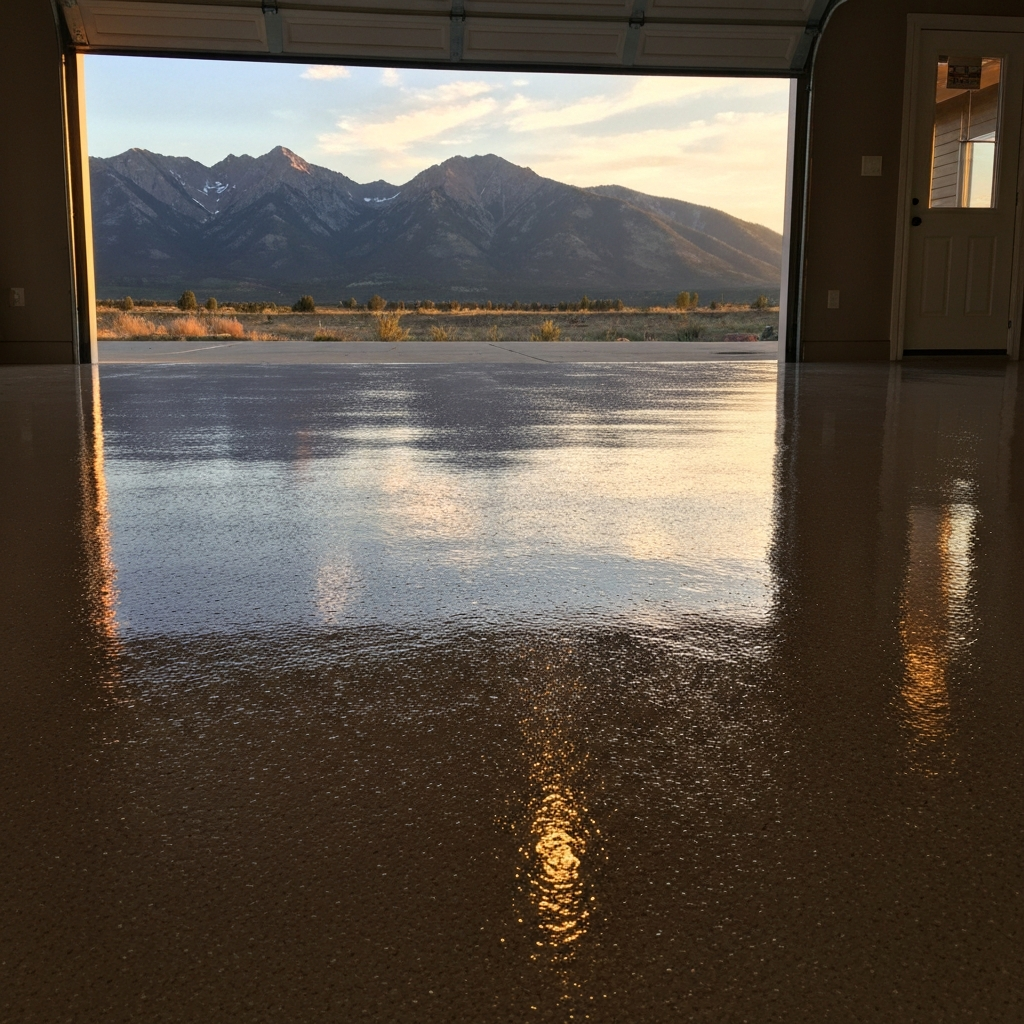
The best garage floor coating for Montana winters is usually a professionally prepared flake system protected by a polyaspartic topcoat. This combination handles tracked-in road deicers, snowmelt, temperature swings, ultraviolet exposure near open garage doors, and summer tire heat better than a basic epoxy-only installation.
A quality epoxy base with a full flake broadcast and polyaspartic topcoat is often the practical workhorse. Straight epoxy can still make sense for a protected, climate-stable garage when budget matters more than installation speed or maximum ultraviolet stability.
Quick Answer: Key Takeaways
- •Best overall: A full-broadcast flake floor with a polyaspartic topcoat.
- •Best practical hybrid: An epoxy base coat for adhesion and build, decorative flake, and a UV-stable polyaspartic wear coat.
- •Best budget option: A properly prepared two-part epoxy system in a heated or temperature-stable garage.
- •Most important factor: Surface preparation and moisture evaluation matter as much as the coating label.
- •Important limitation: No coating can prevent an existing slab from moving or stop active structural cracks from returning.
What Montana Garages Ask of a Floor Coating
A garage floor in the Flathead Valley faces a different workload than one in a mild, dry climate. Vehicles bring in snow, grit, water, magnesium chloride, sodium chloride, and other winter maintenance materials. The floor may remain wet around tires for hours, then dry, cool, and become wet again.
Montana's Department of Transportation uses chloride-based materials to lower water's freezing point and reduce its bond to road surfaces. Those same materials can arrive in a garage as salty slush attached to tires, wheel wells, floor mats, and undercarriages.
A useful garage system therefore needs to address several conditions:
- •Repeated wetting from snow and ice melt
- •Salt and chemical exposure
- •Abrasion from sand and road grit
- •Cold slab temperatures during installation
- •Freeze-thaw movement within existing cracks and joints
- •Sunlight reaching the floor through an open garage door
- •Heat and pressure from tires after summer driving
- •Moisture vapor moving through the slab from below
The finish also needs enough texture for wet boots without becoming so rough that it traps dirt or becomes difficult to mop.
Epoxy vs. Polyaspartic vs. Flake Garage Floors
"Flake" does not describe a separate resin chemistry. A flake floor is a layered system in which decorative vinyl flakes are broadcast into a wet base coat—commonly epoxy or polyaspartic—and then sealed beneath one or more clear topcoats.
Its performance depends on the resin beneath and above the flakes.
| Factor | Epoxy | Polyaspartic | Flake system |
|---|---|---|---|
| Cold-weather cure | Usually more temperature-sensitive and slower in cool conditions | Generally cures faster and can be installed at lower temperatures when product limits are followed | Depends on the base and topcoat; polyaspartic-topped systems are better suited to short cold-weather installation windows |
| Freeze-thaw and salt exposure | Good when fully cured, properly prepared, and maintained | Very good chemical, abrasion, and deicer resistance | Very good when flakes are fully sealed beneath a compatible high-performance topcoat |
| UV stability | Standard epoxy may amber or change color with sunlight | Aliphatic polyaspartic is generally UV-stable | Depends on the topcoat; a polyaspartic clear coat improves color stability |
| Hot-tire pickup | Quality two-part systems resist it, but weak preparation or incomplete cure increases risk | Strong resistance when correctly installed and fully cured | Strong when protected by a suitable wear coat |
| Return to service | Commonly measured in days; exact timing varies by product and conditions | Often allows foot traffic and vehicle return sooner; some systems support next-day vehicle use | Frequently installed as a one-day system, but vehicle timing must follow the specific product requirements |
| Relative cost | Usually lower | Usually higher | Mid-to-high, depending on preparation, number of coats, coverage, repairs, and topcoat |
| Best for | Budget-conscious, protected, temperature-stable garages | Fast turnaround, UV exposure, chemical resistance, and cold-climate use | Residential garages needing texture, appearance, wear resistance, and easier dirt concealment |
Manufacturer data supports the general pattern: polyaspartic coatings are valued for rapid cure and resistance to ultraviolet exposure, while specific systems are also formulated to resist automotive fluids, salts, and chemical deicers.
Actual performance remains product-specific. "Polyaspartic," "epoxy," and "flake" are broad categories, not guarantees of film thickness, adhesion, chemical resistance, or workmanship.
Epoxy Garage Floors: Where They Work and Where They Struggle
Two-part epoxy remains useful because it can bond well to correctly prepared concrete, provide substantial film build, accept a dense flake broadcast, and offer good resistance to common garage spills.
It is especially useful as a base coat in a hybrid system. Its longer working time can help installers wet the prepared surface evenly and broadcast flakes before the material closes.
Epoxy advantages
- •Strong adhesion to mechanically prepared, suitable concrete
- •Good film build for minor surface irregularities
- •Reliable base for decorative flakes
- •Broad color availability
- •Usually less expensive than a full polyaspartic system
- •Good resistance to oil, antifreeze, salt, and ordinary vehicle fluids when the selected product is rated for them
Epoxy limitations
- •Slower cure during cool conditions
- •Narrow temperature and humidity limits for many products
- •Standard formulations may discolor near sunlight
- •Longer waiting periods before parking
- •Greater sensitivity to inaccurate mixing or incomplete cure
- •Low-grade kits may create a thinner film than expected
- •Poor preparation can lead to peeling at tire paths and high-wear areas
Quality epoxy should not be confused with one-part floor paint labeled with epoxy-related wording. A true two-component system cures through a chemical reaction between resin and hardener. Consumer two-part epoxy systems commonly require several days before vehicle traffic, although exact schedules vary.
Best for: A protected garage that can remain within the product's installation range and stay empty long enough for full cure. It also works well as the build coat beneath flakes and a polyaspartic topcoat.
Why Polyaspartic Is Often the Best Garage Floor Coating for Montana Winters
Polyaspartic coatings are commonly selected for Montana garages because they reduce several cold-climate compromises at once. They cure quickly, offer strong abrasion and chemical resistance, and retain color better when exposed to sunlight.
That does not mean every polyaspartic product can be applied to a frozen slab. Air temperature, slab temperature, humidity, dew point, and moisture still need to fall within the manufacturer's limits. One published polyaspartic data sheet, for example, lists working characteristics at temperatures down to approximately 50°F, while other formulations may have different ranges.
The practical advantage is that suitable polyaspartic chemistry generally provides a wider and faster installation window than standard epoxy. In a region where shoulder-season temperatures can change quickly, that flexibility matters.
Polyaspartic advantages
- •Rapid cure and shorter garage downtime
- •Strong resistance to abrasion and common automotive chemicals
- •Better color stability under ultraviolet exposure
- •Good resistance to salt and chemical deicers when the product is rated for them
- •Strong wear-coat performance over decorative flakes
- •Easier next-day return to normal use with many systems
- •Suitable for projects where a long multi-day cure is impractical
Polyaspartic limitations
- •Higher material cost
- •Short working time that demands organized installation
- •Less forgiving of inexperienced application
- •Rapid cure can leave roller marks, missed areas, or uneven texture if poorly managed
- •Not a substitute for moisture testing or mechanical preparation
- •May be too slick when wet unless appropriate texture is incorporated
- •Cure speed and return-to-service claims vary by formulation and temperature
Best for: Montana garages exposed to winter slush, deicers, sunlight, regular vehicle use, and limited installation downtime.
Flake Systems: More Than a Decorative Finish
A flake broadcast provides color variation and visual texture, but it also has practical value. A dense broadcast can help conceal dust, dried water marks, small scratches, and ordinary wear better than a uniform solid-color floor.
The system typically includes:
- Mechanical surface preparation
- Crack and surface repairs where appropriate
- A pigmented epoxy or polyaspartic base coat
- Partial or full decorative flake broadcast
- Scraping and vacuuming of loose flakes
- A clear polyaspartic wear coat
- Optional additional texture or a second clear coat
A full broadcast generally creates a more uniform flake field and provides better visual coverage than a light chip scatter. However, the flakes themselves do not seal the floor. Protection comes from the resin system surrounding them.
Flake-system advantages
- •Hides routine dirt and wear
- •Adds controllable surface texture
- •Offers broad color and blend choices
- •Provides a replaceable wear layer above the original slab
- •Works well with an epoxy-base/polyaspartic-topcoat design
- •Makes repaired areas less visually obvious than a solid-color coating
Flake-system limitations
- •Aggressive texture can be harder to clean
- •A thin or uneven clear coat may leave flake edges exposed
- •Glossy finishes can still be slippery when wet
- •Performance varies significantly with the resin system
- •Flakes do not repair unstable cracks or weak concrete
Best for: Working residential garages where appearance, traction, dirt concealment, and winter durability all matter.
The Montana and Flathead Valley Angle
Freeze-thaw cycling starts with the slab
Concrete contains pores, joints, cracks, and repaired areas where water can collect. When temperatures drop, trapped water can freeze and expand. A coating reduces direct surface absorption, but it does not eliminate movement already occurring within the slab.
Existing control joints should generally remain functional rather than being rigidly buried without a system-specific plan. Active cracks may return through any hard coating. Small dormant cracks can often be repaired, but crack treatment should never be presented as a promise that movement has ended.
The condition of the slab is therefore more important than choosing the hardest-sounding coating name.
Road salt and ice-melt chemicals need prompt cleanup
A properly selected system should tolerate normal exposure to tracked-in deicers, but chemical resistance does not mean the floor should remain covered in concentrated salty water indefinitely.
As snowmelt evaporates, it can leave concentrated residue. Grit suspended in that residue may act like sandpaper beneath tires and boots. Routine rinsing, squeegeeing, or damp mopping reduces the time those materials remain on the finish.
The floor near the garage door and tire paths usually receives the greatest load. Those areas deserve complete preparation, adequate coating thickness, and careful coverage.
Snowmelt is different from moisture vapor
Water carried in by a vehicle lands on top of the coating. Moisture vapor moves upward through the slab from below. The surface may look dry while vapor is still moving through the concrete.
If vapor pressure or alkalinity exceeds what the coating system can tolerate, blistering or delamination can occur. Coating manufacturers therefore recommend evaluating slab moisture rather than assuming that a dry-looking floor is ready.
A moisture concern does not automatically rule out coating. It may change the preparation plan, primer selection, or moisture-mitigation requirements.
Montana has a short, unpredictable installation season
Standard epoxy often slows considerably as temperatures fall. Cold concrete can also fall below the temperature needed for reliable wetting, cure, or intercoat bonding.
The slab temperature—not only the thermostat reading—must be considered. A garage may feel comfortable while the floor remains cold after several freezing nights.
Fast-cure chemistry can make scheduling more practical, but the installer still needs to confirm:
- •Surface and air temperatures
- •Dew point and condensation risk
- •Relative humidity
- •Moisture condition
- •Product-specific recoat windows
- •Safe vehicle return time
Summer creates a hot-tire test
Montana winters get most of the attention, but summer tire heat can expose weak preparation or under-cured materials. Tires warm during highway driving, then press against the same small areas of the floor.
High-quality two-part epoxy and polyaspartic systems can resist hot-tire pickup. Failures blamed on "hot tires" may also involve contamination, weak surface paste, inadequate profiling, excessive moisture, or parking before full cure.
How to Choose the Best Garage Floor Coating for Montana Winters
Start with the garage rather than the product label.
A practical evaluation should consider:
- •Is the garage heated continuously, occasionally, or not at all?
- •Does sunlight reach the floor through the door or windows?
- •How long can the garage remain empty?
- •Are there oil stains, previous coatings, sealers, or tire dressings?
- •Are cracks stable or continuing to move?
- •Does the slab show white deposits, damp areas, blistered paint, or past moisture problems?
- •Is a smoother cleanable finish more important than aggressive traction?
- •Will the space be used for parking, mechanical work, storage, or all three?
For many Flathead Valley homes, the balanced specification is:
Mechanically prepared concrete + necessary repairs + epoxy base coat + full flake broadcast + UV-stable polyaspartic topcoat.
This design uses epoxy where its adhesion, working time, and build are useful, then places polyaspartic chemistry at the exposed surface where ultraviolet stability, rapid cure, abrasion resistance, and chemical resistance matter most.
An all-polyaspartic system can also perform well. The decision should be based on slab condition, environmental limits, product compatibility, installation workflow, and budget—not on the assumption that one resin is automatically superior in every layer.
Surface Preparation Determines Whether the System Can Work
No premium coating can compensate for a weak or contaminated surface.
Garage slabs may contain:
- •Curing compounds
- •Concrete sealer
- •Oil and grease
- •Silicone tire dressing
- •Paint
- •Adhesive
- •Winter residue
- •Weak surface paste
- •Previous coating layers
Mechanical grinding creates a controlled surface profile and removes material that could interfere with adhesion. Edges, corners, cracks, and areas beneath stored equipment require the same attention as the open center of the floor.
Acid etching alone may not remove oil, sealers, tire products, or failed coatings. It also does not provide the same degree of control over surface profile as mechanical preparation.
Preparation is less visible than color flakes, but it is usually the most important part of the project.
Streamline Solutions' Take
"For most working garages in the Flathead Valley, the practical choice is a full flake system with a polyaspartic wear coat. An epoxy base beneath that topcoat remains a strong real-world option because it provides useful working time and film build while placing UV-stable, fast-curing chemistry at the exposed surface. Straight epoxy still has a place in protected, temperature-stable garages where budget is the priority and additional cure time is acceptable."
- Streamline Solutions, Kalispell, MT
How Streamline Solutions Can Help
Streamline Solutions evaluates and protects existing garage slabs throughout the Flathead Valley. Property owners can review the main concrete coating service, learn how polyaspartic floor coatings compare with epoxy garage floors, or explore a flake epoxy system. General planning information is also available through the cost guide and coating FAQs.
Frequently Asked Questions
Related Guides & Services
Concrete Coating
Professional coating services for the Flathead Valley.
Polyaspartic Floor Coatings
Fast-curing, UV-stable systems for garages and shops.
Epoxy Garage Floors
Durable, proven protection for temperature-stable garages.
Flake Epoxy Floors
The practical standard for hiding dirt and adding texture.
Cost Guides
Honest pricing ranges and what drives the cost of an install.
FAQ
Answers to the most common questions we get on site.