
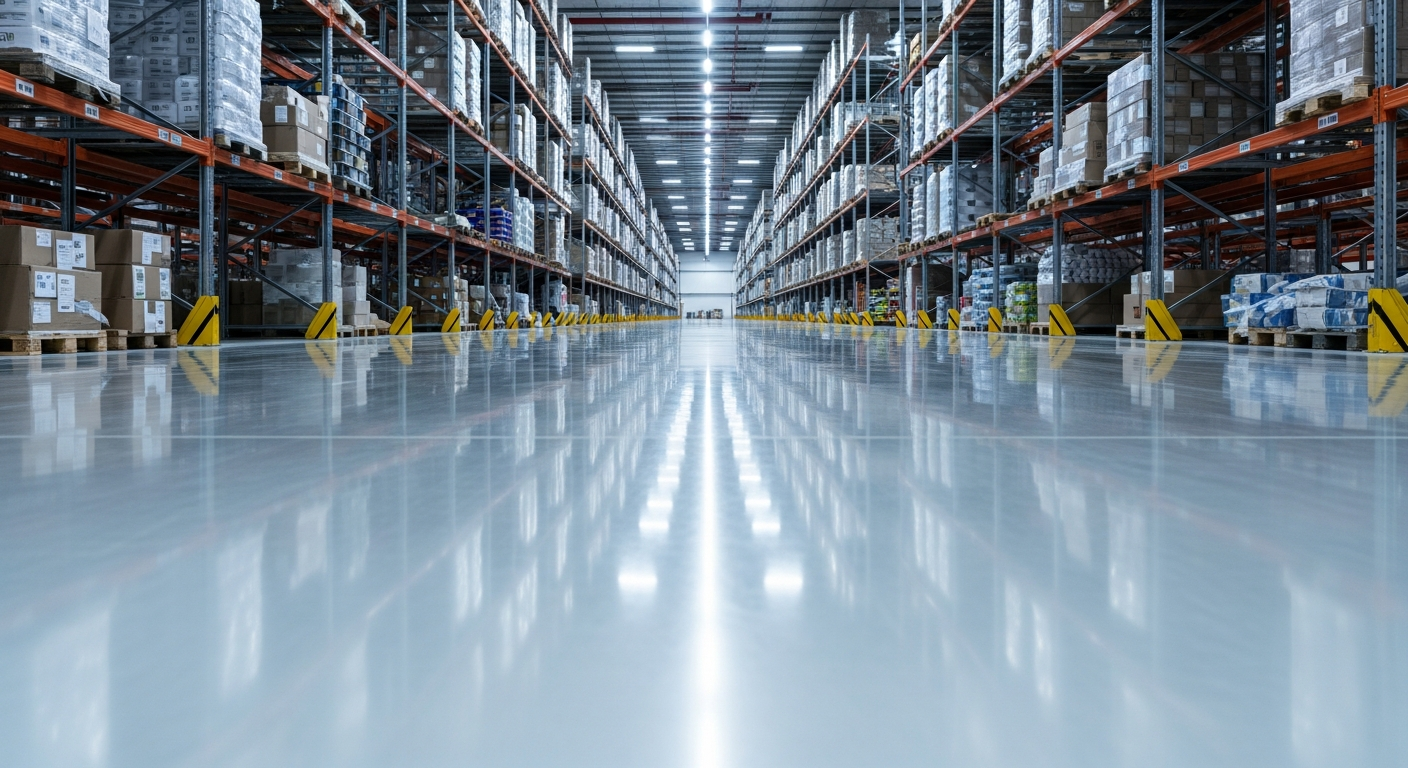
Warehouse & Industrial Floor Coating in Kalispell & Western Montana
Forklift-rated, dust-free, line-stripe-ready coating systems for working warehouses — installed in phases around your operation.
Forklift-Rated Abrasion Resistance
24–72 hr Typical Forklift Return
Integrated Line Striping & 5S Zones
Phased Section-by-Section Installs
What Industrial Traffic and Montana Winters Do to Unprotected Warehouse Slabs
Warehouse and industrial slabs in Western Montana work hard. Forklifts, pallet jacks, loaded racking, dragged pallets, tracked-in snowmelt, road salt, cleaning chemicals, and constant hard-wheel traffic all wear down bare concrete faster than many facility teams expect. When the surface begins dusting, spalling at joints, absorbing stains, or shedding paint, the floor becomes more than a maintenance issue. It starts affecting inventory cleanliness, safety markings, cleaning labor, equipment wear, and the way the space looks to employees, vendors, inspectors, and customers.
Streamline Solutions installs warehouse and industrial floor coating systems for existing concrete surfaces in Kalispell, the Flathead Valley, and Western Montana. We are Concrete Surface Protection Specialists, which means our work is focused on coating, sealing, protecting, restoring, and upgrading existing slabs. We do not pour new slabs, sidewalks, driveways, foundations, or stamped surfaces.
An industrial floor coating system is not the same as rolling down a thin layer of floor paint. A properly specified system starts with mechanical surface preparation, then uses epoxy build coats to create film thickness and durability, followed by a wear-resistant topcoat such as a polyaspartic or urethane-style finish where abrasion resistance, cleanability, and return-to-service timing matter. In wet or slush-prone areas, quartz broadcast can be added for traction. For organized facilities, line striping and safety zone marking can be built into the coating system so aisles, pedestrian walkways, equipment areas, dock zones, and hazard markings become part of the work floor instead of temporary tape or paint that disappears under traffic.
For facility managers, warehouse operators, plant managers, and general contractors, the goal is simple: reduce dust, improve durability, support safer movement, shorten cleaning cycles, and keep the operation running with realistic installation phasing and cure windows.
Bare concrete may look tough, but it is still porous and vulnerable under industrial use. In warehouses and production spaces, the first signs often show up as dust on pallets, dust on inventory, gray residue on equipment, and light surface erosion in main travel lanes. Forklifts and pallet jacks follow the same wheel paths day after day, slowly grinding the surface and opening the slab to more wear.
Hard-wheel traffic is especially demanding. Forklift tires, pallet-jack wheels, carts, and material-handling equipment concentrate weight into narrow contact areas. Over time, that pressure can create surface wear, rutting in traffic lanes, and spalling near control joints or construction joints. Once joint edges start breaking down, the floor becomes rougher for equipment and harder to clean. Those damaged transitions can also create vibration, noise, product movement, and additional impact on wheels and bearings.
Dock doors are another high-failure area in Kalispell and across Northwest Montana. Snow, slush, road salt, gravel, and meltwater get tracked into the building during winter. Cold air near loading zones may meet heated interior areas, creating thermal swings that stress coatings, joints, and bare concrete. If the slab is unprotected, salt and moisture can soak into the surface, accelerating deterioration and staining. If the floor has only been painted, that paint often blisters, chips, scratches, or peels once forklift traffic and moisture begin working against it.
Aggressive cleaning adds another layer of wear. Scrubbers, degreasers, squeegees, and repeated wash-down routines can remove weak coatings and expose soft or dusty concrete. A floor that looks acceptable after a quick repaint may fail fast when the real operating conditions return. That is why warehouse floor coating should be specified around traffic, moisture, cleaning methods, safety needs, and downtime windows—not just color.
Warehouse and Industrial Coating Systems for Existing Slabs
Streamline Solutions installs industrial coating systems for existing warehouse and production floors. Our process begins with the actual slab in front of us: its age, surface hardness, current coating condition, moisture behavior, joint damage, contamination, traffic load, cleaning routine, and the areas that must stay operational during the project. We do not assume every slab needs the same system, and we do not pretend that every floor is a good candidate without testing and inspection.
For many industrial floors, the system starts with mechanical grinding to open the concrete surface and create a proper profile for adhesion. From there, we may specify epoxy build coats where film thickness, durability, and surface restoration are needed. Epoxy is often useful as the body of the system because it can create a strong, protective layer over properly prepared concrete. Where abrasion resistance, UV stability, faster return-to-service, or tougher wear performance is important, a polyaspartic or urethane-style topcoat may be used as the finish layer.
In wet areas, dock approaches, wash zones, entry points, and other slip-sensitive areas, quartz broadcast can be incorporated into the coating. Quartz adds texture and traction while still allowing the surface to be cleaned more effectively than rough, deteriorated bare concrete. The texture level should be matched to the environment. Too little texture may not provide enough grip in wet areas, while too much texture can make cleaning harder in dry warehouse aisles.
Line striping and safety markings can also be built into the system. Aisle lanes, pedestrian walkways, forklift routes, loading zones, staging areas, hazard boxes, equipment pads, and 5S-style organization markings can be added as part of the floor plan. This helps turn the coating from a surface upgrade into an operational tool.
Joint filling, spall repair, and transition repair are especially important for hard-wheel traffic. A beautiful coating over broken joints will not solve the underlying problem. We address joint edges, cracks, surface defects, and rough transitions where appropriate before coating so the finished floor performs better under forklifts, carts, and pallet movement.
We protect, restore, seal, and coat existing concrete & paver surfaces — we do not install new slabs, foundations, sidewalks, stamped concrete, or asphalt.
Six Operational Benefits of a Professionally Specified Industrial Floor Coating
1. Cleaner Inventory, Equipment, and Work Areas
Concrete dust is more than a housekeeping problem. In warehouse and industrial environments, dust can settle on pallets, packaging, stored product, tools, machinery, and racking. A properly prepared and coated slab helps lock down the surface, reducing the dusting that comes from exposed concrete wearing away under traffic. Cleaner floors also support cleaner equipment. Forklifts, pallet jacks, carts, and sweepers move less loose grit through the building, which can help reduce the constant gray residue that appears after every shift.
2. Brighter Aisles and Lower Lighting Strain
A coated industrial floor can improve light reflectivity compared with dark, stained, or dusty bare concrete. In long aisles, storage zones, service areas, and production spaces, a brighter floor can make the facility feel cleaner and easier to navigate. Better reflectivity can also reduce eye strain for employees who are reading labels, operating equipment, or moving through mixed traffic areas. This does not mean the floor becomes a mirror or a showroom surface. Industrial floors still need practical texture, durability, and maintenance routines.
3. Forklift-Rated Abrasion Resistance
Industrial traffic is one of the main reasons thin coatings fail. Forklifts, pallet jacks, dragged pallets, racks, carts, and turning tires create abrasion that standard paint cannot handle for long. A professional system uses proper surface prep, sufficient build, and a wear-resistant topcoat to stand up better to daily movement. No coating is indestructible, and any floor can be damaged by metal scraping, impact, chemical exposure, or neglected maintenance.
4. Faster Cleaning Cycles
Bare concrete absorbs oils, grime, salt residue, moisture, and fine dust. Once those materials settle into open pores or rough patches, cleaning takes longer and results are inconsistent. A coated surface gives your maintenance team a more controlled work floor, which can shorten sweeping, scrubbing, and spill-response routines. Texture matters here. Smooth areas may clean faster but can be slippery when wet. Broadcast areas provide more grip but may require more intentional cleaning.
5. Built-In Safety Zones and Workflow Markings
Line striping and safety markings are not just visual upgrades. In active facilities, markings help separate pedestrians from forklifts, define storage lanes, show staging zones, identify hazards, and reinforce standard operating procedures. When markings are integrated into the coating system, they can last longer than temporary tape or basic surface paint. Common layouts include pedestrian walkways, forklift routes, loading zones, rack clearances, equipment parking, fire access areas, caution zones, and 5S-style organization boxes.
6. Longer Slab Life
A warehouse slab is a major asset. When the surface is left exposed to abrasion, moisture, salt, and impact, the top layer can wear down and the joints can deteriorate faster. Coating the surface helps protect the slab from routine operational abuse and can slow the cycle of dusting, patching, repainting, and emergency repairs. A coating system is not a substitute for structural repair, and it will not fix a slab that is moving or failing below the surface.
System Selection for Industrial Use
Industrial floors should be specified by use, not by a one-size-fits-all product name. The right system for a dry storage warehouse may not be the right system for a service bay, food-related work area, cold dock, or wet processing zone. Streamline Solutions looks at traffic type, downtime limits, moisture, cleaning chemistry, temperature, safety needs, and the condition of the existing concrete before recommending a system.
Epoxy build coats are often used when the floor needs film thickness, surface restoration, and a strong body layer. Epoxy can be a good choice for properly prepared industrial slabs that need durability and coverage over worn concrete. The tradeoff is that epoxy usually needs appropriate cure time and may not be the best exposed finish in every high-abrasion or UV-sensitive environment. In many systems, epoxy performs best as the build layer beneath a more abrasion-resistant topcoat.
Polyaspartic or urethane-style topcoats are often used where abrasion resistance, cleanability, chemical resistance, and faster return-to-service are important. These topcoats can help protect the system from forklift traffic, pallet movement, cleaning routines, and daily wear. The tradeoff is that they still depend on proper prep, correct film build, and the right primer or base system. A premium topcoat over poor preparation is still a poor system.
Quartz broadcast systems are useful where traction matters. Dock doors, wet entries, wash areas, sloped transitions, and zones exposed to snowmelt may benefit from broadcast texture. The tradeoff is cleanability. More texture usually means more grip, but it can also require more effort when scrubbing or removing fine debris. The right answer is usually a zone-based approach: smoother where cleaning speed matters, more textured where wet traction matters.
Our Warehouse and Industrial Floor Coating Process
Site walk and moisture testing. We begin by walking the space, reviewing traffic patterns, looking at joints and surface damage, and identifying dock doors, wet zones, cleaning routines, and operational constraints. Moisture testing helps determine whether the slab is a good candidate for coating and whether special preparation or a different system is needed.
Mechanical grinding and surface preparation. We mechanically grind the existing concrete to remove weak surface material, open the pores, and create a coating profile. This step is one of the biggest differences between a professional system and a short-lived paint job. Adhesion starts with preparation, not with the coating can.
Joint, crack, spall, and transition repair. We address damaged joints, chipped edges, spalled areas, cracks, and rough transitions where appropriate for the system. For facilities with forklifts, pallet jacks, and carts, these repairs matter because hard wheels punish uneven surfaces.
Build coats and broadcast where specified. Depending on the system, we apply epoxy build coats to create thickness, seal the surface, and improve durability. In wet or traction-sensitive areas, quartz broadcast may be added into the coating to create a textured, safer work surface.
Topcoat, striping, cure, and phased turnover. We finish the system with a topcoat selected for the space, then add line striping and safety markings where included in the scope. Return-to-service depends on the products used, temperature, humidity, slab conditions, and traffic type. Foot traffic may return sooner than forklift traffic, and heavy equipment needs a realistic cure window so the floor is not damaged immediately after installation.
For active facilities, we can discuss phased section-by-section installation. That may mean coating one bay, aisle, dock section, or production zone at a time so operations can continue around the work. Phasing requires planning, but it is often the right approach for warehouses that cannot fully shut down.
Related Commercial Floor Coating Services
Shop & Service Bay
For automotive, equipment, fleet, and maintenance spaces. These systems focus on tire traffic, fluids, cleaning, traction, and professional service environments where appearance and durability both matter.
Learn moreShowroom & Retail
For customer-facing commercial interiors, retail spaces, and product display areas. These floors often prioritize appearance, cleanability, light reflectivity, and a polished customer experience while still protecting the existing slab.
Learn moreCommercial Floor Coating Hub
For the full overview of our commercial surface protection work. That page explains how Streamline Solutions approaches commercial coating, sealing, and surface upgrades across different business environments.
Learn moreProfessional Industrial System vs. Floor Paint or Thin-Mil DIY Coatings
Floor paint can make a warehouse look better for a short time, but it is usually not designed for forklift abrasion, hard-wheel traffic, moisture at dock doors, dragged pallets, industrial cleaning, or road salt. Thin coatings also have very little margin for error. Once they scratch, peel, or wear through, the facility is often back to dusting concrete with flakes of failed paint mixed into the debris.
The cost of failure is not just the cost of repainting. A failed coating can disrupt operations, create housekeeping problems, hide damaged joints, make line striping unreliable, and force managers to schedule another shutdown. If a floor fails in front of a customer, inspector, tenant, or ownership group, the visible damage can also create credibility problems.
A professional industrial coating system is more involved because it is designed around preparation, film build, traffic, topcoat selection, repair scope, and cure timing. It usually costs more upfront than paint, but it is intended to reduce repeat downtime and repeated surface failure. For facility managers, the better question is not "What is the cheapest way to change the color of the floor?" It is "What system gives this slab the best chance of performing under our real operating conditions?"
| Feature | Professional Industrial System | Floor Paint / Thin-Mil |
|---|---|---|
| Film Build | Multi-layer systems for strength and durability | Thin application, prone to wearing through |
| Prep | Mechanical grinding to profile the slab | Often just washing or acid etching |
| Forklift Abrasion | High resistance to hard-wheel traffic | Fails quickly under heavy loads and turning tires |
| Salt/Moisture at Docks | Protects against moisture intrusion and salt | Peels when moisture or salt gets under the edge |
| Striping Durability | Integrated into the coating system | Temporary tape or paint that scuffs off |
| Cost of Failure | Designed to reduce repeat downtime | High disruption from frequent repainting |
Where We Serve
Streamline Solutions provides warehouse and industrial floor coating for existing slabs throughout the Flathead Valley and Northwest Montana.
We also serve Missoula for commercial projects only. If your facility is outside the standard service area but you have a larger commercial or industrial project, call 406-909-4342 so we can review the location, square footage, slab condition, and scheduling needs.
Warehouse and Industrial Floor Coating Cost
Industrial floor coating pricing depends on the slab and the system. As a planning range, many warehouse and industrial coating projects fall roughly between $6 and $14+ per square foot, with heavily damaged floors, extensive joint repair, specialty topcoats, quartz broadcast, detailed line striping, and phased scheduling pushing costs higher. Large open areas with sound concrete and simple access may price more efficiently than small, chopped-up spaces with contamination, equipment moves, or strict shutdown windows.
The main cost drivers are square footage, existing coating removal, slab hardness, moisture behavior, surface damage, joint condition, spall repair, crack treatment, system thickness, topcoat selection, traction requirements, striping scope, safety marking layout, and how the work must be phased. Downtime windows matter too. A project that can be completed in one clean shutdown is different from a section-by-section install that has to work around forklifts, inventory, dock schedules, production shifts, or tenant operations.
For a realistic number, call 406-909-4342. We can discuss the facility, the current slab condition, traffic type, cleaning routine, and downtime limits before recommending a system.
Pros & Cons of Industrial Floor Coating Systems
Pros
Industrial coating systems can be a strong investment for the right existing slab. They reduce dust, improve cleanability, protect the surface, brighten work areas, support safety markings, and create a more professional operating environment. They can also help extend the useful life of a slab that is otherwise being worn down by forklifts, pallet jacks, salt, moisture, and cleaning cycles.
Cons
A coating system requires proper preparation, downtime, curing, and realistic expectations. It cannot correct structural slab movement, severe moisture vapor problems, or deep contamination without additional evaluation. Textured systems improve traction but may take more effort to clean. Smooth systems clean faster but may not be right for wet dock areas or slush-prone entries. The best results come from matching the system to the facility instead of forcing one finish into every zone.
Best For vs. Not Recommended For
Best For
Warehouse and industrial floor coating is best for existing slabs in warehouses, distribution spaces, production areas, storage facilities, light industrial buildings, commercial garages, loading zones, equipment areas, and work floors that need dust control, abrasion resistance, cleaning efficiency, and clearer safety organization. It is also a strong option when a facility wants to upgrade from peeling paint, stained concrete, temporary tape, or hard-to-maintain bare slab.
Not Recommended For
It may not be recommended for slabs with unresolved moisture problems, active structural movement, severe contamination, failing substrate, or conditions where the surface cannot be properly prepared. It is also not the right service if you need a new slab poured, a new sidewalk, a new driveway, a foundation, asphalt work, or stamped concrete. Streamline Solutions works on existing surfaces only.
Our Recommendation
For most warehouse and industrial facilities in Kalispell and Western Montana, the right floor system is not the thinnest coating or the fastest cosmetic refresh. It is a practical, properly prepared industrial system built around traffic, moisture, cleaning, traction, markings, and downtime. If forklifts, pallet jacks, dock-door slush, road salt, and daily abrasion are part of your operation, your floor should be specified for those conditions from the start.
— Kalispell Concrete Surface Protection Specialists
